

Interpreter services for healthcare: Essential 2025
Why Clear Communication in Healthcare Can Save Lives
Interpreter services for healthcare connect patients and medical providers who speak different languages, ensuring accurate diagnosis, informed consent, and safe treatment. These services are typically available 24/7 in 200+ languages through three main formats:
- On-Site Interpretation: In-person interpreters for complex, sensitive appointments
- Video Remote Interpreting (VRI): Real-time video connection for visual communication needs, including ASL
- Over-the-Phone Interpreting (OPI): Immediate phone access for quick consultations and emergencies
Professional medical interpreters undergo 120+ hours of specialized training and must follow strict confidentiality standards. Services are free for patients and legally required under Section 1557 of the ACA and Title VI of the Civil Rights Act.
When a nurse needs to explain a critical treatment plan to a non-English speaking patient, a simple tablet can bridge the gap. Within seconds, a certified medical interpreter appears on screen, allowing the conversation to flow naturally. The patient understands, asks questions, and leaves with confidence. This scenario plays out thousands of times daily, where clear communication is paramount.
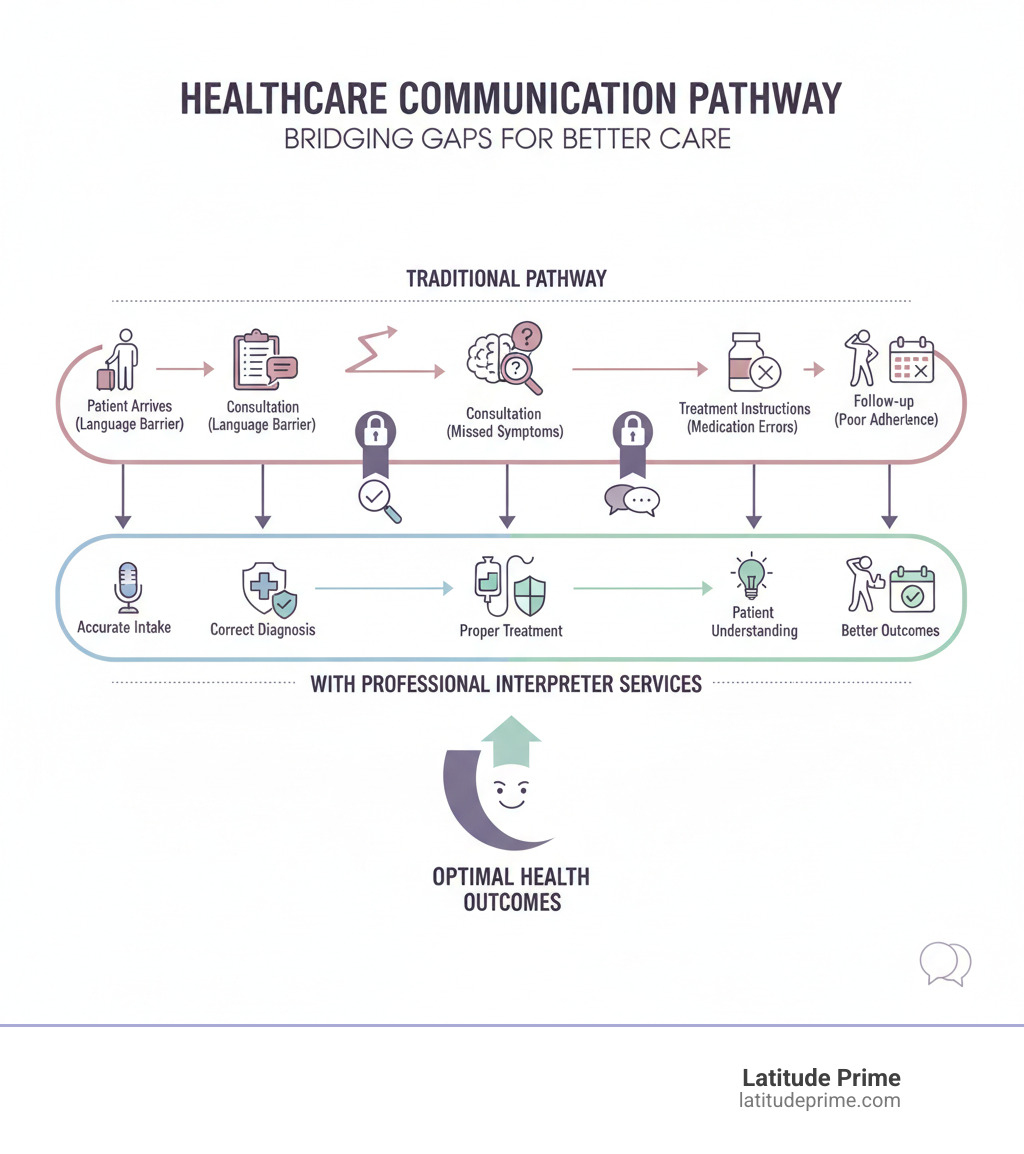
More than 25 million people in the U.S. have limited English proficiency, and over 12 million are Deaf or Hard of Hearing. Without professional language support, these patients face a higher risk of misdiagnosis, medication errors, and poor health outcomes.
Professional interpreter services bridge the communication gap that can mean the difference between a missed diagnosis and timely treatment, between confusion and informed consent. This guide walks you through how different interpretation modes work, what qualifications matter, and how to ensure compliance with healthcare regulations.
The Critical Role of Professional Interpreters in Patient Care
For millions of people, a routine doctor’s visit can be terrifying when you don’t speak the same language as your provider. When you can’t understand your diagnosis or treatment plan, anxiety and fear take over. This communication gap is where professional interpreters play a vital role in ensuring patient safety.

When a trained medical interpreter enters the room—whether in person or on a screen—the tension eases. The patient understands their diagnosis, and the doctor gets a full picture of symptoms and concerns. This isn’t just about convenience; it’s about patient safety at its most fundamental level. Clear communication leads to more accurate diagnoses, fewer medical errors, and better patient outcomes. It empowers patients to give genuine informed consent and exercise their patient autonomy—rights that should never depend on language.
The Primary Benefits of Using Professional Interpreter Services for Healthcare
The impact of professional interpretation goes far beyond just translating words. It builds a complete bridge for understanding.
- Improved Communication: A professional interpreter conveys meaning, context, and medical terminology accurately, eliminating dangerous guesswork.
- Builds Patient Trust: When patients feel understood in their own language, they are more likely to share crucial symptoms and ask questions.
- Reduces Readmission Rates: Clear discharge instructions mean patients understand how to manage their care at home, preventing return visits.
- Improves Treatment Adherence: Patients who understand the ‘why’ behind their treatment plan are more likely to follow it.
- Provides Dignity and Respect: Language access ensures every patient is a full participant in their own care, maintaining control over their medical decisions.
Who Benefits from Language Access?
Language access transforms healthcare for everyone involved in the care process.
- Limited English Proficient (LEP) Patients: For the 25 million LEP individuals in the U.S., interpretation is the bridge to proper treatment.
- Deaf, DeafBlind, and Hard-of-Hearing (DHH) Patients: Over 12 million Americans in the DHH community rely on specialized services like American Sign Language to communicate clearly. For comprehensive support, explore more about our interpretation services.
- Doctors and Physicians: Providers can focus on medicine when they receive complete medical histories and are confident their explanations are understood.
- Nurses and Support Staff: From intake to discharge, nurses use interpreters to provide better, more comfortable care.
- Paramedics and First Responders: In emergencies, quick phone interpretation can provide life-saving information about allergies or medical history.
- Mental Health Professionals: In therapy, where nuance and cultural context are critical, professional interpreters ensure nothing gets lost. Learn more about specialized support in interpreter health and social care.
Navigating the Different Types of Interpreter Services for Healthcare
Think of interpreter services for healthcare like having the right tool for the job. Understanding which type of interpretation works best for each situation ensures patients get the support they need, exactly when they need it. Modern services are available 24/7, with on-demand access for urgent needs and advance scheduling for planned appointments. At Latitude Prime, we provide interpretation in over 300 languages, serving diverse communities nationwide.
Modes of Interpretation: Finding the Right Fit
Each mode of interpretation has its sweet spot, and choosing wisely makes all the difference in patient care.
On-site interpretation brings a professional interpreter physically into the room. This is ideal for complex or sensitive appointments like cancer diagnoses or mental health sessions, where body language is essential for building trust. It fully supports American Sign Language (ASL) and group settings but requires advance scheduling. Learn more about On-Site Interpretation Services.
Video remote interpreting (VRI) is a popular and flexible option. An interpreter appears on a tablet screen, providing the benefit of visual cues without the logistics of an in-person visit. VRI is excellent for telehealth, medium-complexity appointments, and is particularly valuable for ASL interpretation. It can be accessed on-demand or scheduled. Dive deeper into Video Remote Interpreting Healthcare.
Over-the-phone interpreting (OPI) is the rapid-response solution. When an ER needs to know about allergies or a pharmacist needs to clarify a prescription, OPI connects to an interpreter in seconds. It is audio-only and best for quick consultations, emergencies, or rare languages. This mode is for spoken languages only and is not suitable for ASL.
| Mode of Interpretation | Best Use Case | Visual Cues | Availability | Support for ASL |
|---|---|---|---|---|
| On-Site Interpretation | Complex, sensitive, or lengthy appointments; group settings; situations requiring physical interaction; highly emotional conversations. | Crucial (body language, facial expressions) | Scheduled in advance | Yes, via ASL interpreters |
| Video Remote Interpreting (VRI) | Medium-complexity appointments; situations where visual interaction is beneficial but an in-person interpreter isn’t feasible; telehealth. | Important (facial expressions, gestures) | On-demand or scheduled | Yes, via VRI for ASL interpreters |
| Over-the-Phone Interpreting (OPI) | Quick consultations; emergencies; prescription refills; brief check-ins; rare languages where VRI/on-site might be limited. | Not available, relies solely on audio | On-demand (often <20 seconds) | No, spoken language only |
How to Access and Pay for Interpretation
Accessing these services is straightforward.
- For patients: Simply tell any staff member you need an interpreter upon arrival, or mention it when booking your appointment. Services are completely free for patients. Healthcare organizations that receive federal funding are legally required to provide language access at no charge.
- For healthcare providers: Partnering with a language service agency like Latitude Prime provides instant access to qualified interpreters through dedicated platforms and apps. We also arrange scheduled on-site or remote interpreters. If you’re exploring options, check out Medical Interpreter Agencies Near Me.
Interpretation vs. Translation: What’s the Difference?
Though often used interchangeably, these services are distinct.
Interpretation is for spoken or signed language in real time. It’s the dynamic, live conversation that happens during a doctor’s appointment, consultation, or emergency room visit.
Translation is for written documents. It’s the careful process of converting text like medical records, consent forms, discharge instructions, and prescriptions from one language to another. Professional medical translation requires specialized expertise to avoid critical errors. Understanding Medical Translation and Why You Should Hire a Professional.
In short: interpretation is for conversations, and translation is for documents. Both are vital for comprehensive language access.
Upholding Standards: Quality, Confidentiality, and Legal Requirements
In healthcare, “good enough” isn’t an option. When a patient’s health is on the line, every word matters. That’s why professional interpreter services for healthcare are built on a non-negotiable foundation of quality, confidentiality, and legal compliance. At Latitude Prime, our ISO-certified quality management system ensures every interpretation meets strict international benchmarks for excellence.

Interpreter Qualifications and Training
Medical interpretation is a specialized skill that demands extensive training. Our interpreters are highly trained professionals, not just bilingual individuals.
- Specialized Training: Each interpreter completes more than 120 hours of training focused on medical terminology, anatomy, and procedures in over 300 languages.
- Ongoing Education: We require at least 10 hours of continuing education annually to keep skills sharp and knowledge current.
- Cultural Competency: Interpreters are trained to steer cultural nuances that can impact a patient’s understanding and adherence to care.
- Certification: We prioritize certification from bodies like the Certification Commission for Healthcare Interpreters (CCHI) and the National Board of Certification for Medical Interpreters (NBCMI). Our dedication to quality is reflected in our company-wide standards: We are a Certified ISO 17100 and CAN-CGSB 131.10 company. Read more here.
Ensuring Patient Confidentiality and Privacy
Trust is the cornerstone of healthcare. We guard patient confidentiality with the utmost vigilance.
Every aspect of our service is fully HIPAA compliant. Before joining our network, all interpreters sign legally binding non-disclosure agreements (NDAs) to protect all confidential information. For remote interpretation, we use only secure, encrypted platforms to safeguard personal health information (PHI). Protecting patient privacy is woven into every step of our process, guided by professional codes of ethics and legal mandates. For more information about privacy practices, you can review general guidelines at our Privacy Policy.
Legal and Regulatory Mandates
Providing language access in healthcare is not just good practice—it’s the law. Several federal mandates create a clear obligation for providers to ensure language is not a barrier to care.
- Section 1557 of the Affordable Care Act (ACA) prohibits discrimination based on national origin, which legally requires language assistance for LEP individuals.
- The Americans with Disabilities Act (ADA) mandates effective communication for individuals with disabilities, including providing qualified sign language interpreters for Deaf and Hard of Hearing patients.
- Title VI of the Civil Rights Act requires any program receiving federal funds to provide meaningful access to services for LEP individuals.
Together, these laws create a clear legislative obligation for communication access. Compliance ensures that every patient receives the safe, equitable, and dignified care they deserve. In Canada, similar rights were established in the landmark case Eldridge v. British Columbia (Attorney General).
Modern Solutions and Best Practices for Effective Communication
As healthcare evolves, so does language access. Technology now makes it easier than ever to connect patients with interpreters, integrating communication seamlessly into clinical workflows. However, with these innovations, it’s equally important to avoid common pitfalls that can compromise patient safety.
The Dangers of Using Unqualified Interpreters
In a busy clinic, it’s tempting to use a bilingual staff member or a patient’s family member for a quick interpretation. However, this practice is dangerous and should be avoided.
- Errors and Omissions: Untrained individuals are far more likely to make critical mistakes with medical terminology, which can lead to misdiagnosis or medication errors.
- Emotional Burden: Asking a family member to interpret a serious diagnosis places an unfair emotional burden on them and compromises impartiality.
- Breach of Confidentiality: Family and staff are not bound by the same strict HIPAA rules and codes of ethics as professional interpreters.
- Machine Translation: Automated translation apps are not suitable for clinical use. They cannot grasp nuance, cultural context, or emotional tone, and they cannot ask clarifying questions when a patient is confused.
The Role of Technology in Medical Interpretation
Purpose-built technology is revolutionizing how interpreter services for healthcare are delivered.
Video Medical Interpreter services are now a cornerstone of telehealth, providing crucial visual cues for both spoken languages and ASL. Modern platforms integrate directly with Electronic Health Records (EHR), allowing providers to launch and document an interpretation session from the patient’s chart. This integration with EHR and telehealth systems like Zoom or Microsoft Teams streamlines workflows and improves compliance. Furthermore, on-demand apps on tablets and smartphones connect providers to interpreters in under 20 seconds for most languages, ensuring critical care is never delayed by a language barrier. Explore our Video Medical Interpreter solutions.
Meeting the Needs of Deaf, DeafBlind, and Hard-of-Hearing Patients
Language access must include visual languages for Deaf, DeafBlind, and Hard-of-Hearing (DHH) patients.
- American Sign Language (ASL): ASL is a complete language, not just signed English. Qualified ASL interpreters are essential for clear communication. Our American Sign Language (ASL) Interpretation Services are designed to meet these needs.
- Deaf Interpreters (DIs): In complex cases, a DI, who is a Deaf individual with specialized training, works alongside an ASL interpreter to ensure full understanding.
- Communication Access Realtime Translation (CART): This service provides word-for-word transcription of spoken language onto a screen, which is invaluable for DHH individuals who prefer to read text.
Best Practices for Communicating Through an Interpreter
Following a few simple guidelines can make interpreted conversations more effective.
- Speak directly to the patient, not the interpreter. Maintain eye contact with the patient.
- Use short, clear sentences. Pause after each complete thought.
- Pause frequently to allow the interpreter time to convey your message accurately.
- Avoid jargon and idioms. Use plain language whenever possible.
- Check for understanding periodically by asking the patient if they have questions.
Frequently Asked Questions about Healthcare Interpreting
Navigating healthcare is complex enough without a language barrier. Here are straightforward answers to the most common questions about interpreter services for healthcare.
How quickly can I access a medical interpreter?
For common languages, on-demand phone (OPI) and video (VRI) services connect you to a qualified interpreter in under a minute, 24/7. For in-person appointments or less common languages, scheduling in advance is recommended to guarantee availability.
Are interpreter services free for patients?
Yes, absolutely. In the U.S., healthcare organizations that receive federal funding are legally required to provide and pay for language access services. Patients should never be charged for an interpreter. This is a right protected by laws like the Affordable Care Act and the Civil Rights Act.
What is the difference between a certified medical interpreter and a bilingual staff member?
This is a critical distinction for patient safety. A certified medical interpreter has completed extensive training (often 120+ hours) in medical terminology, ethics, and privacy laws like HIPAA. They are tested for accuracy and impartiality.
A bilingual staff member, while fluent in two languages, lacks this specialized training. Using an untrained person can lead to dangerous errors, breaches of confidentiality, and an unfair emotional burden, especially if they are a family member. For high-stakes medical conversations, a certified professional is essential.
Conclusion
In healthcare, effective communication is a fundamental right, not a privilege. You deserve to be heard, to understand your care, and to make informed decisions. Professional interpreter services for healthcare are essential for patient safety, health equity, and legal compliance, bridging the gap that can lead to misdiagnosis or medication errors.
A comprehensive range of solutions exists to meet every need. Whether it’s an emergency requiring immediate phone interpretation, a sensitive consultation best served by on-site support, or a telehealth appointment using video, the right option is available 24/7 in over 300 languages. This ensures no patient is left without a voice, whether in Minneapolis, Washington D.C., San Diego, Miami, or anywhere else.

Choosing a certified, professional language services partner like Latitude Prime makes all the difference. Our ISO-certified quality management system and network of expert linguists guarantee accuracy, confidentiality, and cultural sensitivity. When every word matters, we are here to bridge the critical language gap.
We believe that trust, understanding, and better health outcomes should be accessible to everyone. That’s what drives us to provide world-class interpretation and translation services. Because clear communication doesn’t just improve care—it can save lives.
For comprehensive language support custom to your organization’s needs, explore our Medical Healthcare Translation & Interpretation Services.
