
Medical prescription translation: 24h Vital Safety
Why Medical Prescription Translation Matters for Your Health and Safety
Medical prescription translation is the accurate conversion of a provider’s medication instructions from one language to another. Whether you’re traveling, living in a new country, or helping a patient with limited English proficiency, understanding a prescription correctly can be a matter of life and death.
Quick Answer: What You Need to Know
- What it is: Professional conversion of prescription instructions—medication names, dosages, and directions—into your language.
- Why it matters: Misunderstanding a prescription can lead to incorrect dosage, wrong medication, or dangerous drug interactions.
- When you need it: Traveling internationally, moving abroad, filling foreign prescriptions, or for non-English speaking patients.
- Who should do it: Certified medical translators with healthcare expertise—never free online tools.
- How fast: Professional services can deliver in under 24 hours for urgent needs.
For millions of people with Limited English Proficiency (LEP), a prescription in an unfamiliar language is incomprehensible. The stakes are high, as a misunderstanding can lead to consequences ranging from mild side effects to fatal outcomes.
The challenge goes beyond words. Prescriptions contain specialized terminology, Latin abbreviations, and complex dosage units that require medical knowledge to interpret correctly. Combined with notoriously illegible handwriting, the risk of error is significant without professional help.
In today’s interconnected world, language barriers shouldn’t compromise healthcare. Whether you’re an expatriate, a healthcare provider, or a patient, accurate translation is essential for safety.
Why Accurate Prescription Translation is a Non-Negotiable for Patient Safety
For millions worldwide, a prescription can be a confusing mix of foreign words, cryptic abbreviations, and illegible scribbles. This is why accurate medical prescription translation is not a luxury but an absolute necessity for patient safety.
Even in one’s native language, prescriptions are notoriously hard to decipher. The infamous “doctor’s handwriting,” combined with medical abbreviations and Latin terms, can baffle anyone. A pharmacist knows that “Sig: 1 tid pc” means “take one, three times a day after meals,” but to a patient, it’s meaningless. For a helpful overview of common Rx abbreviations, see List of abbreviations used in medical prescriptions.
The complexity doesn’t stop there. Medical abbreviations vary by region, and dosage units must be converted with absolute precision. There’s no room for error when dealing with milligrams versus milliliters or whether a medication is taken twice or three times daily. A small mistake can mean the difference between healing and harm.
The consequences of mistranslation are frightening. An incorrect dosage can lead to an overdose or leave a condition untreated. The wrong medication can trigger severe allergic reactions or adverse drug interactions. These errors also create serious legal implications for everyone involved. The stakes couldn’t be higher, which is why we explore this topic in our guide on Understanding Medical Translation and Why You Should Hire a Professional.
The Dangers of DIY and Machine Translation
It’s tempting to use a free, instant translation app on your phone. But for medical prescription translation, using these tools is like playing Russian roulette with your health.
Free tools lack the medical context to understand crucial nuances. They can’t distinguish between similar-looking abbreviations or account for different brand names in other countries. A machine might translate a drug name to one that doesn’t exist in your country or, worse, to a similar-sounding but dangerously different medication.
Furthermore, when you upload a prescription to a free tool, you have no guarantee of confidentiality. Your sensitive health information could be stored or accessed by unknown parties.
| Feature / Aspect | Free AI Translation | Professional Human Translation |
|---|---|---|
| Accuracy | Low, prone to errors, lacks medical context | High, medically accurate, contextually precise |
| Medical Terminology | Inconsistent, often incorrect | Expert-level, specialized knowledge |
| Nuance & Context | Poor, often misses subtle meanings | Excellent, captures cultural and medical nuances |
| Confidentiality | Non-existent, data may be stored/used | Strict, adheres to HIPAA/GDPR, secure protocols |
| Legal Validity | None, not certified | Often certified, legally recognized |
| Patient Safety Risk | High, potential for severe adverse events | Minimal, focuses on preventing errors |
| Cost | Free | Fee-based, but an investment in safety |
The bottom line is that medical documents require medical experts. Your health is worth the investment in professional translation.
When is Prescription Translation Necessary?
Several common scenarios make professional medical prescription translation essential.
International travel is a frequent reason. If you run out of medication on vacation, a local pharmacy will need a clearly translated prescription to help you. A professional translation ensures you can continue your treatment without interruption.
Moving abroad means entering a new healthcare system. Your new doctors and pharmacists need to understand your medication history to ensure continuity of care and prevent dangerous gaps in treatment.
For healthcare providers serving Limited English Proficiency (LEP) patients, translated prescriptions are an ethical and often legal requirement. When patients understand their instructions, they are more likely to follow them correctly, leading to better health outcomes. Providing translated materials, along with On-Site Interpretation Services, ensures equitable care.
Communicating with foreign healthcare providers also requires accurate translation. Whether you’re consulting a specialist overseas or coordinating care for a family member, translated prescriptions facilitate clear communication.
Finally, filling prescriptions in another country often requires translation for verification. Pharmacists must confirm the medication, dosage, and legality under their country’s regulations. A professional translation provides the necessary clarity and validity.
The Professional Medical Prescription Translation Process Explained
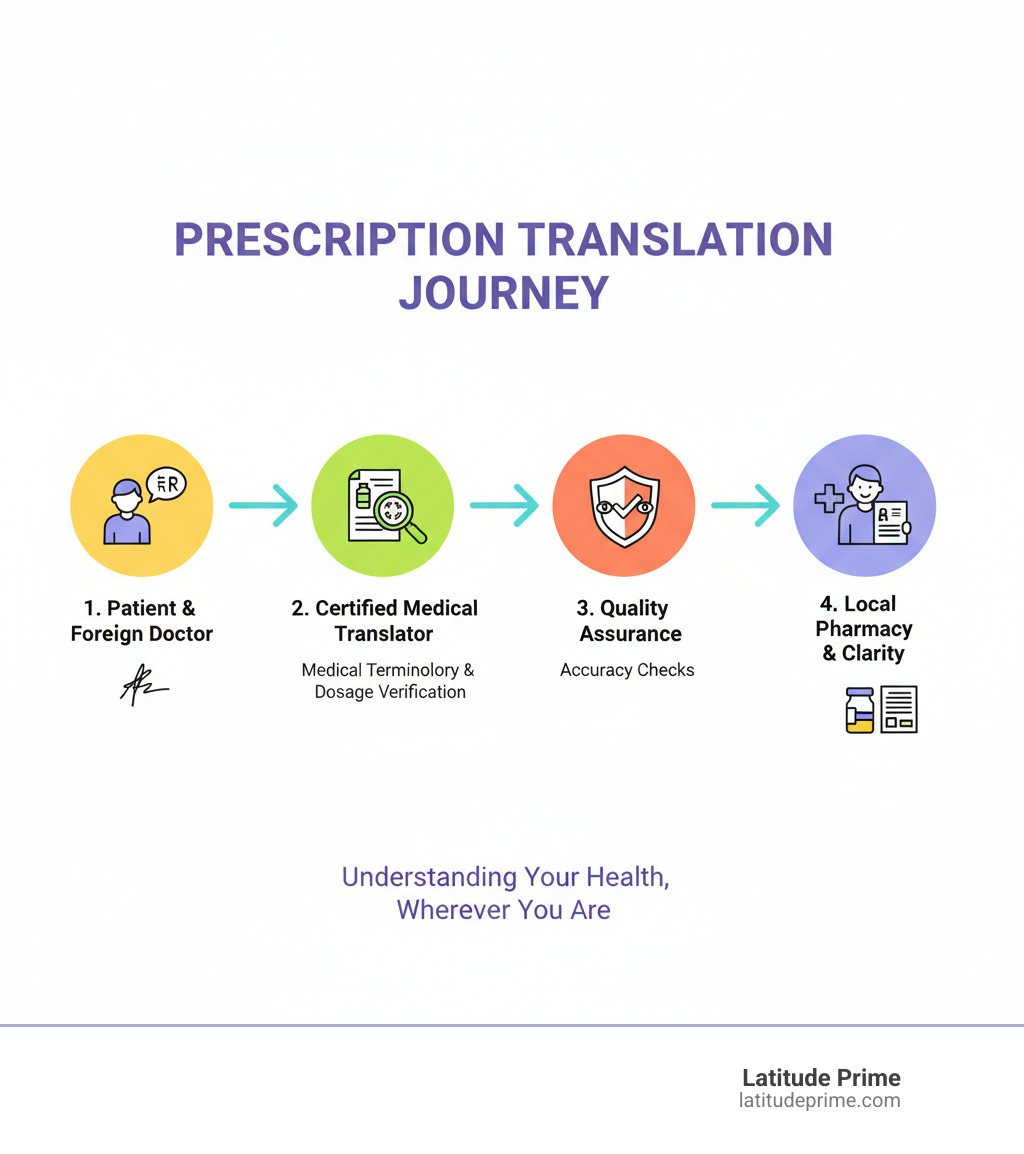
When your health is on the line, a word-for-word conversion isn’t enough. At Latitude Prime, our medical prescription translation process is a meticulous, multi-layered system designed to prioritize accuracy and safety.

The journey begins when you submit your prescription for a transparent quote. We then assign it to a subject-matter expert—a translator with genuine medical expertise who understands critical distinctions, like the difference between “bid” (twice daily) and “qid” (four times daily).
Your document then moves through our comprehensive translation, editing, and quality assurance phases. Only after passing these stringent reviews is the final translation delivered. Our entire Document Translation service is built on this foundation of precision.
Step 1: Decoding and Recreating the Source Document
Doctor’s handwriting is notoriously difficult to read. Our first task with any handwritten or scanned prescription is to accurately decode what’s written.
We may use Optical Character Recognition (OCR) to convert typed documents, but this technology often fails with handwritten notes and medical shorthand. This is where human expertise is irreplaceable.
Our translators carefully recreate the document, transcribing every detail. If any part is ambiguous, such as a dosage that could be “mg” or “mcg,” we don’t guess. We contact the original practitioner for clarification. This commitment to accuracy is paramount.
We leverage advanced Language Technology to support this phase, but always under careful human oversight.
Step 2: Ensuring Accuracy in medical prescription translation
Accuracy in medical prescription translation is the result of a systematic process and qualified professionals.
Our translators are not just bilingual; they are medical specialists, including former nurses, pharmacists, and doctors. They understand the clinical context behind the words, such as the difference between a brand name like “Lasix” and its generic equivalent, “furosemide.”
We use extensive translation memory tools and custom glossaries to ensure consistency. For example, we won’t switch between “acetaminophen” and “paracetamol” unless it’s appropriate for the target country, preventing dangerous confusion.
Every prescription is reviewed by multiple experts. After the initial translation, a second qualified linguist edits the work for accuracy and clarity. A third professional then proofreads the final version. For highly critical prescriptions, we may use back-translation—where a third linguist translates the document back to the original language to verify that no meaning was lost.
This multi-layered approach is why we stand behind every translation. While we offer AI-Powered Machine Translation Post-Editing (MTPE) Services for some documents, prescriptions almost always receive full human translation due to their critical nature.
Step 3: Handling Confidentiality and Data Security
Your medical information is deeply personal and deserves the highest level of protection. At Latitude Prime, we treat your privacy as seriously as we treat translation accuracy.
We are fully compliant with HIPAA and GDPR regulations, the gold standards for protecting health information. All files are handled according to strict protocols to prevent unauthorized access.
We use encrypted, secure file transfer protocols for all submissions and deliveries. Your prescription never travels through unsecured channels. Every translator and staff member signs a comprehensive Non-Disclosure Agreement before working with us.
Our internal systems have multiple safeguards to protect your Private Health Information (PHI) at every stage. This commitment to confidentiality is integral to our Medical & Healthcare Translation and Interpretation Services.
Key Elements of a Prescription That Demand Perfect Translation
A medical prescription is a coded message where every detail matters. For medical prescription translation, getting each element perfect is essential for patient safety.

- Patient information: Your full name and date of birth must be translated precisely to ensure the medication goes to the right person.
- Prescribing doctor’s details: The doctor’s name, credentials, and contact information must be clear for verification, a crucial safety check.
- Date of issue: This determines if the prescription is still valid and marks the start of the treatment plan.
- Medication name: This requires extreme precision. Translators must specify brand versus generic names, as similar-sounding names can refer to different drugs (e.g., Celebrex vs. Celexa).
- Dosage strength and form: Is it 500mg or 5mg? A tablet or a liquid? A tenfold error in dosage could be fatal, and the wrong form could be ineffective or dangerous.
- Instructions for use (Sig codes): Cryptic abbreviations like “1 tab po bid prn” (“take one tablet by mouth twice daily as needed”) must be translated into clear, understandable language for the patient.
- Quantity to dispense: This tells the pharmacist how much medication to provide.
- Number of refills: This indicates if you can get more medication without a new prescription.
- Doctor’s signature and credentials: This validates the entire prescription, confirming it was authorized by a licensed professional.
Different countries also have specific regulatory requirements. For instance, five essential criteria are common for a valid prescription: the patient’s name, date, international drug name and dosage, treatment duration, and the doctor’s signature. These elements must be translated accurately and cannot be altered, ensuring the prescription’s legality. This is why professional medical prescription translation is non-negotiable.
Navigating the Practicalities: Types, Costs, and Legalities
When you need a medical translation, practical questions about time, cost, and legal validity are common. Let’s cover these key considerations.
Time is often critical in healthcare. Professional medical prescription translation services are designed for urgency, with many providers delivering a certified translation in under 24 hours. For longer medical documents, translators typically handle about 2,500 to 3,000 words per day, balancing speed with accuracy.
The cost of translation depends on several factors, including per-word pricing, the language pair, and document complexity. A typed prescription is more straightforward than a handwritten one. Urgency fees may apply for rush services. Since every situation is unique, we encourage you to Get a Free Quote for a clear estimate based on your document and timeline.
Common Types of medical prescription translation
While standard medication prescriptions are the most common, other types also require precise translation.
- Eyeglass prescriptions contain specialized optical measurements (sphere, cylinder, axis) that must be translated perfectly for ordering glasses abroad.
- Cross-border prescriptions may be needed for international travel. It’s wise to ask your doctor for one before you leave.
- Prescriptions for controlled substances face stricter regulations and require extra care in translation to meet local legal standards.
Our expertise extends beyond individual prescriptions to clinical trial documents and pharmaceutical packaging. You can explore our full range of Biotech & Pharmaceutical Translation and Interpretation Services.
Legal and Regulatory Considerations
The legal requirements for medical prescription translation vary by location and purpose.
For official uses like insurance claims or visa applications, you’ll need a certified translation. This includes a formal statement from the translation service attesting to its accuracy and completeness.
In some cases, notarization may be required, where a notary public verifies the translator’s identity. This is less common for prescriptions but may be needed for certain legal processes.
An important reality check: a translated prescription is not automatically valid everywhere. The validity of foreign prescriptions depends on national and local pharmacy policies. Some countries may require you to see a local doctor first.
For insurance reimbursement for medications bought abroad, you will almost certainly need a certified translation of the prescription and receipts.
Navigating this legal maze is why working with professionals matters. Our comprehensive Medical & Healthcare Translation and Interpretation Services not only provide the translations you need but also help you understand the specific requirements for your situation.
Frequently Asked Questions about Medical Prescription Translation
It’s natural to have questions about something as important as your health. Here are straightforward answers about medical prescription translation.
Can I use a free online tool to translate my prescription?
No, and please don’t risk it. While tempting, free online tools are not built for medical documents. They lack the medical context, nuance, and confidentiality required.
These tools can’t differentiate between similar-sounding drugs or understand complex medical abbreviations. A single error could lead to taking the wrong dose or a dangerous medication combination. Furthermore, you have no guarantee of privacy when uploading sensitive health information to a free service.
Professional medical prescription translation services use vetted medical linguists who understand the stakes, ensuring the safety and precision that no automated tool can match.
How can I ensure my prescription is valid when I travel abroad?
Planning ahead is key. Before you travel, ask your doctor for a “cross-border prescription,” which may be more easily recognized internationally.
Next, always get a professional, certified translation. This can make all the difference at a foreign pharmacy. The certification is a formal statement of the translation’s accuracy.
However, even a perfect translation doesn’t guarantee validity everywhere. Each country has its own pharmaceutical regulations. Some may require you to see a local doctor, especially for controlled substances. Researching your destination’s rules beforehand can save you significant stress.
How long does it take to get a prescription translated?
We understand that medical needs are often urgent. Professional translation services prioritize these documents.
For a standard prescription, you can typically receive a certified translation in under 24 hours. Our processes are designed to be both fast and accurate.
The exact turnaround time depends on the prescription’s complexity and the language pair, but we always treat medical documents with the urgency they require. If your situation is especially urgent, let us know when you submit your request.
Conclusion: Communicate with Confidence for Better Health

Your health is too important to leave to guesswork. As we’ve explored, professional medical prescription translation is the only way to steer the risks of language barriers in healthcare and ensure every instruction is crystal clear.
The contrast is stark. Free online tools offer speed but risk dangerous inaccuracies. Professional translation offers peace of mind, delivered by medical linguists who understand the critical difference between a milligram and a milliliter.
This is about more than just converting words; it’s about patient empowerment. A clear prescription allows you to take control of your treatment, ask informed questions, and communicate effectively with healthcare providers anywhere in the world.
At Latitude Prime, our ISO-certified quality management system and network of expert linguists ensure your medical prescription translation receives the precision it deserves. We understand that behind every document is a person who needs to get better.
Your health shouldn’t be compromised by a language barrier. Communicate with Confidence Across Cultures and ensure every medical instruction is understood.
Don’t trust your wellbeing to automated tools. For expert, certified translations that prioritize your safety, explore our professional Medical & Healthcare Translation and Interpretation Services. When it comes to your health, clarity is essential.
