

Legal Translation Services: Your Ultimate Guide 2025
Why Legal Translation Services Are Critical for Global Legal Operations
Legal Translation Services connect legal professionals, businesses, and individuals to accurate, certified translations of complex legal documents across languages and jurisdictions. Whether for international business, cross-border litigation, or immigration, professional legal translation ensures your documents maintain their legal validity and precise meaning.
Quick Answer: What You Need to Know
- What they are: Specialized services that convert legal documents between languages while preserving legal terminology and enforceability.
- Who needs them: Law firms, corporations, government agencies, and individuals dealing with international legal matters.
- Common documents: Contracts, court filings, patents, immigration documents, wills, and corporate policies.
- Key requirement: Certified translators with both linguistic expertise and legal knowledge.
- Typical cost: Starting around $0.085-$0.10 per word, or $19.95-$24.95 per page.
- Industry standards: ISO 17100 and ISO 9001 certifications for quality assurance.
The stakes in legal translation are incredibly high. A single mistranslated term can void a contract, compromise a case, or result in a rejected application. This is why legal translation is a specialized discipline, requiring professionals who understand not just language, but legal systems, terminology, and the consequences of imprecision.
The global legal translation market, valued at $7.1 billion in 2022, is projected to reach $13.5 billion by 2030, reflecting the growing need for cross-border legal support. This guide will walk you through everything you need to know about legal translation services, from understanding the required expertise to choosing the right provider.
The Foundations: Why Legal Translation is a Unique Discipline
Legal documents are packed with specialized terminology and built on precision that can make or break a case. This is why Legal Translation Services exist as a specialized discipline—it takes far more than fluency in two languages. Translating terms like “estoppel” or “force majeure” involves navigating complex legal concepts that may not have a direct equivalent in the target language’s legal system. Getting it wrong can invalidate a contract or derail litigation.
This field demands subject matter experts who understand both the language and the law. It’s a discipline where linguistic skill meets legal knowledge, and both are non-negotiable.
Certified Legal Translators vs. General Translators
Choosing between a general translator and a certified legal translator is like choosing between a family doctor and a neurosurgeon for brain surgery. Certified legal translators possess a unique combination of skills:
- Linguistic Expertise: Native-level fluency in both the source and target languages, with a deep understanding of nuance and precision.
- Legal Knowledge: A firm grasp of legal principles, terminology, and procedural frameworks. Many hold advanced degrees like J.D.s or LL.M.s or have earned specialized certifications in legal translation.
- Subject Matter Specialization: Expertise in specific practice areas, such as intellectual property, immigration, or corporate law, where language varies significantly.
These professionals undergo a rigorous vetting process, including stringent testing and continuous training, to ensure their skills remain sharp. At Latitude Prime, we invest heavily in our legal linguists because their expertise is the foundation of quality work. For those interested, you can learn more about careers in the language industry.
The Core Challenges in Legal Translation
Legal translation presents unique challenges that require specialized skills:
- Complex Terminology: Legal jargon like “habeas corpus” or “amicus curiae” has specific, non-obvious meanings that demand deep legal understanding.
- Lack of Direct Equivalents: Legal concepts often lack one-to-one translations. For example, the common law concept of a “trust” has no exact equivalent in many civil law systems. A skilled translator must find the closest functional match, often with explanatory notes.
- Cultural Nuances: Legal systems are rooted in culture. A translator must understand these subtleties to preserve the original legal intent.
- Time Sensitivity: Court deadlines, merger closings, and patent filings create immense pressure where speed is critical, but accuracy cannot be sacrificed.
- Confidentiality: Legal documents contain privileged and sensitive information, making absolute security a legal and ethical requirement.
The Importance of Understanding Different Legal Systems
Translating legal documents without understanding different legal systems is a recipe for disaster. The world’s legal systems primarily fall into two categories: Common Law (used in the US, UK) and Civil Law (prevalent in Europe, Latin America). They differ fundamentally in how laws are created and interpreted.
These jurisdictional differences mean that a concept central to one system may not exist in another. A legal translator must understand the legal function and context to convey meaning accurately, not just translate words.
To simplify cross-border document acceptance, the Hague Convention of 1961 established the Apostille Certificate. An Apostille certifies a document’s authenticity, allowing it to be accepted by other member countries without further legalization. However, the Apostille does not certify the quality of the translation itself. That’s where professional Legal Translation Services are essential to ensure the document is not just linguistically correct but legally operative in its new jurisdiction.
Who Needs Legal Translation and For What Documents?
The need for legal translation services spans our globalized world, from a Fortune 500 company finalizing a merger to a family reuniting through immigration. All share a critical need for precise, reliable translation of documents that carry legal weight.
Key Clients: From Global Corporations to Individuals
Our clients are diverse, yet united by the need for accuracy:
- Law Firms: From boutique practices to Am Law 200 firms, they rely on us for cross-border litigation, M&A, patent filings, and regulatory compliance. When a case hangs in the balance, precision is paramount.
- Corporations: Businesses operating internationally require translations for trade agreements, contracts, corporate governance documents, and internal policies. We offer specialized Business & Finance Translation & Interpretation Services to help them steer global commerce.
- Government Agencies: We provide secure and precise Official Government Translation & Interpretation Services for international relations, immigration processing, and multilingual legal proceedings.
- Individuals: We assist people pursuing education abroad, navigating immigration, or settling international estates. Their documents—birth certificates, academic transcripts, wills—are pathways to new lives, and we handle them with the care they deserve.
Common Documents That Need Legal Translation Services
The variety of documents we translate reflects our interconnected world. Absolute precision is critical for:
- Contracts and Agreements: Partnership agreements, NDAs, purchase orders, and real estate leases. A single mistranslated clause can void a deal.
- Court Filings: Pleadings, judgments, depositions, and evidentiary materials. An inaccurate translation can compromise an entire case.
- Patents and Intellectual Property: Patent applications, trademark registrations, and prior art documents require translators with both legal and technical expertise.
- Immigration Documents: We follow strict guidelines set by USCIS for birth certificates, marriage certificates, passports, and visas to ensure acceptance.
- Wills and Trusts: These ensure a person’s final wishes are honored across borders.
- Corporate and Financial Documents: Employee handbooks, compliance guidelines, and financial statements for multinational operations.
We also translate emails, text messages, and other digital communications that serve as evidence, paying close attention to context and tone. Learn more about our comprehensive Document Translation services.
Beyond the Written Word: Legal Interpretation

Not all legal communication is written. Legal interpretation transforms spoken words between languages in live settings, ensuring justice isn’t lost in translation. Our legal interpreters work in high-pressure environments where accuracy and composure are essential.
We provide interpretation for:
- Depositions: Ensuring clear communication between attorneys and witnesses.
- Court Hearings: Upholding the right to a fair trial for non-English speakers.
- Client Meetings: Enabling confidential communication between counsel and clients.
- Arbitrations: Providing precise linguistic mediation to help parties reach fair outcomes.
Our interpreters are available for on-site interpretation in locations like Minneapolis, Washington D.C., and Miami, and we offer remote solutions worldwide. The skill required is extraordinary, demanding mental agility and absolute accuracy. Learn more about our specialized Legal Court Interpreter services.
The Hallmarks of Professional Legal Translation Services
When dealing with legal documents, “good enough” is never acceptable. Professional legal translation services are built on three pillars: unwavering accuracy, internationally recognized quality, and ironclad security.
Ensuring Unwavering Accuracy and Quality
Legal accuracy is about preserving the intent, legal effect, and context of every provision. A single error can undermine a legal argument or change the meaning of a contract.
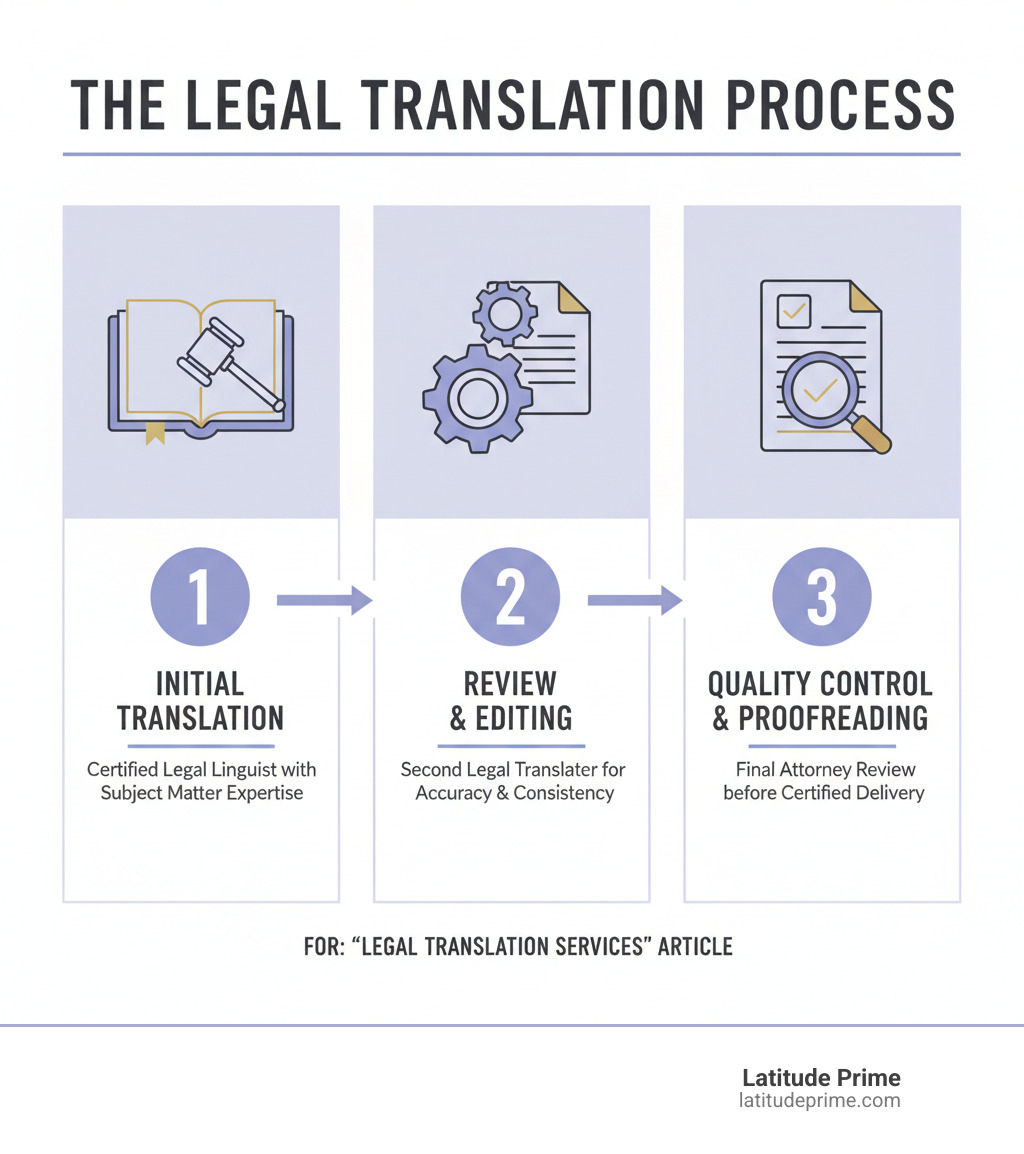
Our process is built on multiple layers of expert review to prevent this:
- Initial Translation: A certified legal linguist with subject matter expertise translates the document.
- Editing: A second, independent legal translator reviews the work, comparing it line-by-line against the source for accuracy and consistency.
- Proofreading: A final check catches any grammatical errors or formatting issues.
This rigorous process is backed by our ISO 9001:2015 (Quality Management) and ISO 17100:2015 (Translation Services) certifications. These standards ensure our quality procedures are structured, documented, and regularly audited. We also maintain legal glossaries and client-specific style guides to guarantee consistency across all your documents.
The Role of Technology in Modern Legal Translation

While human expertise remains at the core of legal translation, technology is an indispensable partner for delivering faster, more consistent, and cost-effective results.
- Translation Memory (TM): A database that stores previously translated sentences. When a similar phrase appears, the system suggests the existing translation, ensuring consistency, speeding up turnaround, and lowering costs for repeated content.
- Computer-Assisted Translation (CAT) Tools: These platforms integrate TM with terminology management and quality checks, allowing multiple translators to work on large projects with perfect consistency.
- Machine Translation (MT) with Post-Editing: For high-volume projects, we can leverage advanced MT as a first step. However, this raw output is always refined by an expert human linguist to ensure legal accuracy and proper terminology. This hybrid approach reduces costs and delivery times without sacrificing quality.
Upholding Strict Confidentiality and Security
Your legal documents contain privileged information, trade secrets, and sensitive data. Protecting this information is a top priority.
We take this responsibility seriously, implementing multiple layers of security:
- Non-Disclosure Agreements (NDAs): Every team member who handles your documents signs a strict, legally binding NDA.
- Secure File Transfers: We use Secure File Transfer Protocol (SFTP) and 256-bit SSL encryption for all data, both in transit and at rest.
- ISO 27001 Certification: This international standard for Information Security Management Systems demonstrates our systematic approach to identifying and controlling security risks.
- Secure Client Portals: You can upload, track, and download your projects within a protected environment, reducing the risks associated with email.
We have built our infrastructure around protecting your sensitive information, because we understand that confidentiality is an absolute requirement in the legal world.
How to Choose the Right Legal Translation Provider
Choosing the right legal translation services provider is a critical decision. You’re selecting a partner to protect your interests across language barriers. You don’t need to be a translation expert to make a smart choice—you just need to ask the right questions.
Key Questions to Ask Your Potential Provider
Before committing, have a conversation with any potential provider. A reputable company will welcome your questions. Here’s a checklist:
- Translator Qualifications: Who will handle your documents? Ask about their legal training, certifications, and specific experience in your area of law (e.g., IP, immigration, litigation).
- Quality Assurance Process: How do they ensure accuracy? Ask about their review process (e.g., separate editors and proofreaders) and if they hold ISO certifications.
- Confidentiality Measures: What security protocols are in place? Inquire about NDAs, data encryption, and secure file handling.
- Certification Process: What does their certified translation include? This is crucial for submissions to courts or government agencies.
- Relevant Experience: Have they handled cases or documents similar to yours? Ask for references or testimonials from clients in your industry.
Decoding Certifications and Credentials
Certifications are your assurance that a provider meets rigorous industry standards.
- ISO Certifications: Look for ISO 9001:2015 (quality management), ISO 17100:2015 (translation services), and ISO 27001 (data security). These show a commitment to documented, auditable processes.
- Professional Memberships: Membership in organizations like the American Translators Association (ATA) indicates a commitment to professional standards and ethics.
- USCIS Compliance: For U.S. immigration documents, the provider must follow the strict guidelines set by USCIS. This includes a signed certificate of accuracy attesting to the translator’s competency. Failure to comply can lead to application rejection.
Finding the Best Value in Legal Translation Services
In legal translation, “cheapest” rarely equals “best value.” An error-filled translation can lead to voided contracts or lost litigation, costing far more in the long run.
Pricing is typically per word (often $0.085 to $0.10) or per page (usually $19.95 to $24.95). Costs vary based on language pair, complexity, and urgency. Rush services are available for a premium.
To find the best value, focus on the complete package: a provider with ISO certifications, experienced legal translators, and a robust quality process will save you money by getting it right the first time. The smartest move is to request a detailed quote. Every project is different, and a reputable provider will offer a transparent estimate based on your specific needs. We make this easy—you can Get a Free Quote for a clear breakdown of your project costs.
Frequently Asked Questions about Legal Translation
Navigating legal translation services can bring up many questions. Here are answers to some of the most common ones we hear.
What is the difference between certified, sworn, and notarized translation?
These terms are often confused but have distinct meanings:
-
A Certified Translation is standard for official use in the United States. The translation is accompanied by a signed statement from the language services provider or translator attesting that the translation is a complete and accurate rendering of the original document. This is what agencies like USCIS require, and it follows the guidelines set by USCIS.
-
A Sworn Translation is required in many civil law countries (e.g., Spain, France, Germany). A sworn translator is an individual who has been authorized by a government body (like a court) to translate official documents. Their translations are stamped and considered legally valid in that jurisdiction.
-
A Notarized Translation involves a notary public witnessing the translator signing the certificate of accuracy. The notary is not verifying the translation’s quality but rather the identity of the person signing the certificate. This adds a layer of authentication that some institutions require.
If you’re unsure which type you need, we can help guide you based on the document’s destination and purpose.
How much do legal translation services typically cost?
Pricing for legal translation services varies based on several factors:
- Volume: The number of words or pages in the document.
- Language Pair: Common languages (like English to Spanish) are generally more affordable than rarer ones.
- Complexity: A simple birth certificate costs less to translate than a complex patent application requiring specialized legal and technical knowledge.
- Urgency: Rush services for same-day or next-day delivery are available at a premium.
- Formatting and Certification: Additional services like desktop publishing or notarization can affect the final price.
As a general guideline, standard translation ranges from $0.085 to $0.10 per word. Certified translations are often priced per page, typically $19.95 to $24.95 per page. The best way to determine the cost for your project is to Get a Free Quote for a precise, no-surprise estimate.
Can I use free online tools for legal document translation?
While tools like Google Translate are convenient, you should never use them for legal documents. Here’s why:
- Inaccuracy: Even at 90% accuracy, the remaining 10% error rate can have disastrous consequences in a legal context. A single mistranslated word can change the meaning of a contract or get an application rejected.
- No Legal Expertise: These tools do not understand legal terminology, cultural nuances, or the differences between legal systems. They cannot replicate the judgment of a human legal expert.
- Confidentiality Risks: Uploading a sensitive document to a free tool may mean you are giving the platform rights to your data, creating a major security and privacy breach.
- No Certification: Free tools cannot provide the certified translation required by courts, government agencies, and other official bodies. You will have to pay for a professional translation anyway.
Legal translation requires human expertise to preserve legal meaning and validity. Trusting an expert is an investment in peace of mind and a successful outcome.
Conclusion: Your Partner for Global Legal Communication
Navigating the global legal landscape requires understanding different languages, legal systems, and the critical weight of every word. Professional legal translation services are not a luxury but a necessity for anyone involved in cross-border legal matters.
Throughout this guide, we’ve highlighted the difference between general and legal translation, the challenges involved, and the importance of a rigorous quality process. From multinational corporations to individuals navigating immigration, the need for precision, confidentiality, and expertise is universal. A misunderstood contract clause or an imprecise immigration form can have severe consequences, which is why professional quality control and security are essential.

At Latitude Prime, we’ve built our reputation on understanding these stakes. Our ISO-certified quality management system is a commitment to excellence in every project. With a network of expert linguists in over 300 languages, we ensure you’re working with professionals who understand both the language and the law.
We serve clients across the United States—from Minneapolis to Miami—and around the world. Whether you’re a law firm, corporation, government agency, or individual, we’re here to ensure your legal communications are accurate, compliant, and culturally appropriate. Language barriers shouldn’t create legal liabilities.
Ready to handle your international legal matters with the precision they demand? Explore our comprehensive Legal Translation & Interpretation Services or Get a Free Quote for your specific needs. Let’s ensure your message is not just translated, but truly understood.
