Medical Device Translation Service: Premier 2025
Why Medical Device Translation Service Matters for Global Success
A medical device translation service provides specialized language solutions for manufacturers who need to translate technical documentation, regulatory submissions, and user materials into multiple languages for global markets. These services ensure compliance with international regulations like EU MDR and FDA requirements while maintaining accuracy that protects patient safety.
What to Look for in a Medical Device Translation Service:
- ISO Certifications – ISO 13485 for medical devices and ISO 17100 for translation quality
- Subject-Matter Expertise – Translators with medical degrees or life sciences backgrounds
- Regulatory Knowledge – Understanding of EU MDR, IVDR, FDA, and country-specific requirements
- Terminology Management – Custom glossaries and translation memory for consistency
- Full Lifecycle Support – From R&D through post-market surveillance
- Data Security – HIPAA compliance and secure file handling protocols
As a manufacturer, distributor, or marketer of medical devices, your products are vital in helping to safeguard patients’ health. But what if the medical professionals who operate your products or the individuals who might use them are not fluent in the source-language of your printed instructions? It puts everyone, including your company, at risk.
The global medical device market is expanding rapidly, particularly in emerging markets across Asia, Latin America, and Africa. This growth brings tremendous opportunity—but also complex challenges. You’re not just translating words. You’re navigating a maze of regulatory requirements across multiple jurisdictions, ensuring technical accuracy that could mean the difference between safe operation and serious adverse events, and managing demanding timelines that determine your speed to market.
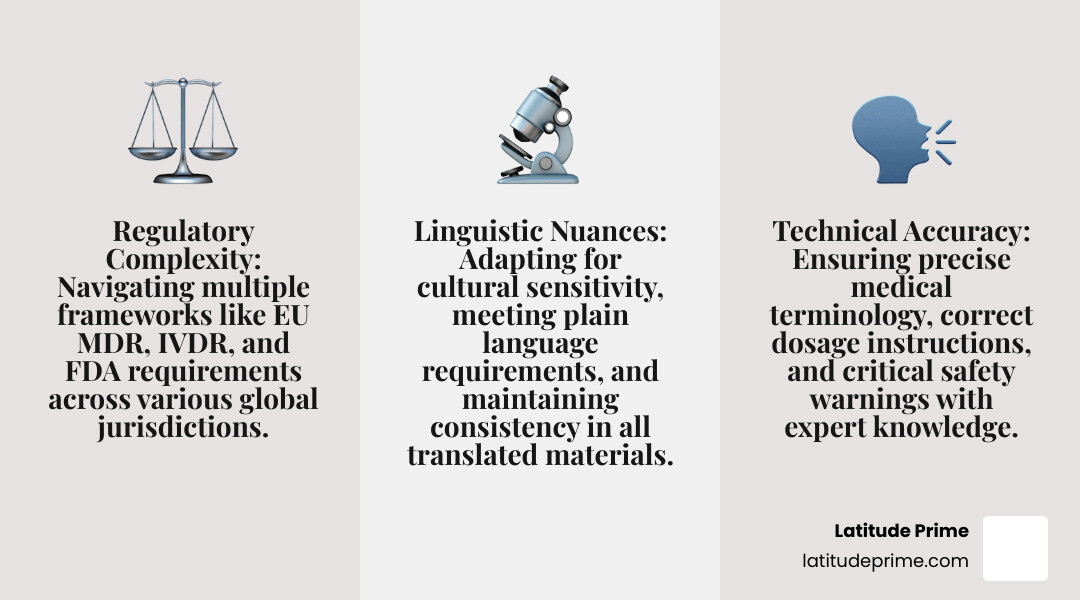
Medical device translation requires expertise that spans three critical domains: linguistic precision, medical knowledge, and legal compliance. A mistranslation in dosage instructions or a misunderstood warning label can lead to device misuse, patient harm, product recalls, and significant legal liability. Many leading translation providers employ translators who hold medical degrees or PhDs specifically because this field demands such specialized understanding.
The stakes are particularly high under regulations like the European Union Medical Device Regulation (EU MDR) and In Vitro Diagnostic Regulation (IVDR), which impose stringent requirements for documentation in all official languages of target markets—potentially all 24 EU languages for devices sold across the European Union.
Why Accurate Medical Device Translation is Non-Negotiable
Imagine a surgeon receiving a new device with poorly translated instructions. A critical warning is missed, the device is used incorrectly, and a patient is harmed. The manufacturer faces lawsuits, penalties, and reputational damage. This preventable scenario highlights why an accurate medical device translation service is not just a compliance checkbox—it’s the bridge between your innovation and patient safety. It protects your brand, ensures legal compliance, and builds the trust healthcare professionals and patients need.
As the manufacturer, you are responsible for every translated document, even if a local partner handles the translation. This accountability is part of your quality management system, making the choice of a translation partner essential. When translation goes wrong, the consequences include adverse events, product recalls, legal liability, and patient harm. For more on why professional expertise is vital, see our guide on Understanding Medical Translation and Why You Should Hire a Professional.
The Crucial Link to Patient Safety
Medical devices are designed to save or improve lives, but this purpose is defeated if users cannot operate them safely. Clear instructions, accurate warnings, and unambiguous dosages are the foundation of safe device use. A single mistranslated phrase in the instructions for an insulin pump or a defibrillator can lead to life-threatening user error.
This is why precision is paramount. A medical device translation service must use translators who understand medicine, not just language. They must provide plain language translations that maintain technical accuracy and cultural sensitivity. Done right, translation prevents misuse, reduces health risks, and gives users the clarity they need to operate your devices as intended.
Gaining and Maintaining Global Market Access
The global medical device market offers enormous opportunity, especially in emerging markets in Asia and Latin America. However, each country has its own regulatory gatekeepers and language requirements. You cannot simply use English instructions everywhere; each market has specific, legally binding rules for translation.
A professional medical device translation service helps you steer these trade barriers and meet local requirements efficiently. Compliant translations lead to faster speed to market, giving you a competitive advantage. While competitors are delayed by regulatory reviews, you can be selling your device to patients. The right partner doesn’t just translate; they help you turn regulatory complexity into a pathway for growth.
Cracking the Code: Regulatory Requirements and Content Types
The medical device industry is heavily regulated for good reason: patient health is at stake. When entering international markets, you’re not just translating words; you’re navigating a complex maze of regulatory compliance and review cycles that vary by jurisdiction. Most regulatory bodies demand that all materials be available in the official languages of the countries where you sell.
The European Union Medical Device Regulation (EU MDR) and In Vitro Diagnostic Regulation (IVDR), for instance, set demanding standards, potentially requiring translation into all 24 official EU languages. In the U.S., the FDA has its own comprehensive guidelines. For specifics, see the official European Union Medical Device Regulation (EU MDR) and the FDA’s Device Labeling guidelines.
Key Regulatory Frameworks You Must Know
Our medical device translation service is built around these evolving regulations. Here are the critical frameworks we steer for you:
The EU Medical Device Regulation (MDR 2017/745) and In Vitro Diagnostic Regulation (IVDR 2017/746) have dramatically increased documentation requirements for manufacturers entering the EU.
In the United States, FDA 21 CFR Part 820 (Quality System Regulation) outlines strict documentation control and labeling standards, where accuracy is non-negotiable.
ISO 13485:2016 is the international standard for quality management systems for medical devices. A translation provider with this certification demonstrates they meet the same quality and regulatory requirements as manufacturers.
ISO 14971:2019 addresses risk management. Translations of risk assessments and related documents must accurately convey risk information without ambiguity.
Content Requiring Translation Across the Product Lifecycle
Translation is required for nearly all documentation throughout your device’s lifecycle. Our Document Translation services are designed to handle this complexity.
Instructions for Use (IFUs) and user manuals are top priority, as errors can directly cause patient harm.
Product labels and packaging must clearly communicate warnings, symbols, and UDI codes in compliance with regional regulations.
Software user interfaces (UIs) and electronic IFUs (eIFUs) require translation to ensure intuitive and safe user interaction, as software is often classified as a medical device.
Clinical Evaluation Reports (CERs) and Summary of Safety and Clinical Performance (SSCPs) are essential regulatory submissions for EU market access and must be available in required languages.
Marketing materials like brochures and websites need cultural adaptation to resonate with local audiences while maintaining technical accuracy.
Training and eLearning modules ensure that medical professionals and sales teams understand your device correctly in their native language.
Regulatory submissions, including Declarations of Conformity and technical files, must be in the languages required by each authority. Installation manuals are often needed for market clearance.
Technical documentation like biocompatibility reports and verification and validation documents often need translation for regulatory review.
Ongoing post-market surveillance (PMS) reports and safety updates must be translated for relevant authorities to maintain compliance.
The Core Components of a Premier Medical Device Translation Service
Choosing a medical device translation service means selecting a partner to handle your most high-stakes content. A premier service is built on five pillars: quality management systems, subject-matter expertise, technology integration, scalability, and data security. At Latitude Prime, our Life Sciences Translation & Interpretation Services are built around these components, giving your content the specialized attention it demands.
Human Expertise vs. Machine Translation
While machine translation (MT) has improved, the life-or-death nature of medical device documentation requires human expertise. Our translators are not just linguists; they are subject-matter experts, often with MDs or PhDs in life sciences. They understand complex clinical terminology and the subtle context that algorithms miss. We vet every linguist and match their specialty to your content, ensuring a cardiologist reviews heart monitor documentation or a biomedical engineer handles a surgical robot interface.
MT does have a role in our workflow. For large volumes or initial drafts, our AI-Powered Machine Translation Post-Editing (MTPE) Services combine AI speed with the critical review of human experts. However, regulators expect critical content like IFUs and labels to be human-produced or human-validated with a traceable quality process. Pure MT without expert post-editing is not acceptable for regulated documents due to the high risks.
Ensuring Accuracy with Terminology Management
Consistency in terminology is non-negotiable for preventing dangerous misunderstandings. Our process begins by creating custom bilingual glossaries for each client. These glossaries act as a single source of truth for approved terms, ensuring a “cannula” is always translated the same way in every language.
We pair glossaries with Translation Memory (TM) technology, which stores and reuses previously translated segments. This guarantees consistency across all documents while reducing costs and turnaround times. We also implement rigorous in-context reviews, where linguists check translations within the final document layout or software interface to ensure the text not only reads correctly but also fits properly.
The Importance of an ISO-Certified Medical Device Translation Service
In an industry where precision saves lives, certifications are proof of a commitment to internationally recognized standards. When evaluating a medical device translation service, ISO certifications reveal how seriously they take quality management.
ISO 13485 is specific to the medical device industry. For a translation provider, it demonstrates that our processes meet the stringent, risk-based demands manufacturers face and are designed to support your regulatory compliance with traceable, auditable steps.
ISO 17100 is the standard for translation services, defining best practices for the entire workflow, from translator qualifications to quality assurance. It ensures our process is robust, reliable, and repeatable.
ISO 9001 is the foundation for quality management, signifying our commitment to meeting customer and regulatory requirements and to continuous improvement.
Together, these certifications create a comprehensive framework of auditable processes that reduces your risk. When regulators inquire about your translation process, you can point to our ISO-certified system as evidence of compliance.
Strategic Partnership: From R&D to Post-Market Surveillance

An effective medical device translation service is a strategic partner who supports you through the entire product lifecycle. At Latitude Prime, we are with you from R&D and clinical trials to manufacturing and post-market surveillance. This comprehensive approach ensures consistency, faster turnarounds, and cost-savings, as we learn your devices, terminology, and preferences.
This partnership is critical in today’s regulatory landscape. The EU MDR, for example, has increased the linguistic burden on post-market surveillance, requiring rapid, meticulous translation of safety updates and reports. A partner who already knows your products helps you meet these demanding deadlines without sacrificing quality. For comprehensive support, explore our Biotech & Pharmaceutical Translation & Interpretation Services.
Specialized Service Areas
Our service offers specialized expertise for every stage of the device lifecycle.
Regulatory and compliance translation: We translate IFUs, SSCPs, technical files, and labeling with a deep understanding of EU and FDA requirements to ensure your submissions pass review cycles the first time.
Clinical trials and R&D: We handle clinical protocols, informed consent forms, and patient-reported outcomes with linguists who have specific clinical research expertise. This includes IQ/OQ/PQ documentation and risk management files (ISO 14971).
Software and UI localization: We localize device software, embedded systems, and mobile apps with linguistic accuracy and cultural appropriateness, including functional testing to ensure the UI works as intended.
Marketing and corporate communications: We adapt marketing collateral and websites to resonate with global audiences while maintaining technical accuracy and brand consistency.
Training and educational materials: We translate eLearning modules, training manuals, and multimedia content. We also provide Interpretation services for training sessions, webinars, and regulatory meetings.
Ensuring Confidentiality and Data Security
We understand the critical need to protect your sensitive data, including protected health information (PHI), proprietary specifications, and intellectual property. Our approach to data security is built into our operations.
We maintain HIPAA compliance through rigorous safeguards and team training. All document transfers occur via secure file transfer protocols (SFTP), and our project management systems feature role-based access controls. All team members sign comprehensive non-disclosure agreements (NDAs) to legally protect your confidential information. Our robust internal security policies include strict access controls, secure data storage, and clear data retention and destruction protocols, giving you peace of mind.
Frequently Asked Questions about Medical Device Translation
When it comes to translating medical devices for global markets, manufacturers often have questions about responsibilities, regulatory acceptance, and what to look for in a translation partner. Let’s address the most common concerns we hear from companies like yours.
Who is responsible for compliant medical device translations?
Here’s something that surprises many people: even if you work with a distributor or local partner who handles the translation process, the manufacturer is ultimately responsible for the quality and compliance of all translated content. This responsibility isn’t something you can outsource or delegate away—it’s part of your overall quality management system.
While distributors may handle local translation by agreement, the accountability under your quality system remains with you, the manufacturer. This is why choosing a reputable and experienced medical device translation service is so critical. You’re not just selecting a vendor; you’re choosing a partner whose work becomes part of your regulatory compliance framework.
Think of it this way: if a poorly translated instruction leads to a device misuse or adverse event, regulators will look to you, not your distributor. That’s why we work so closely with manufacturers to ensure every translation meets the same rigorous standards as your original documentation.
Will regulators accept machine translation for medical devices?
This is one of the most frequently asked questions we receive, and the answer is nuanced but clear. For critical content like Instructions for Use (IFUs), labeling, or clinical reports, regulators expect translations to be human-produced or, at minimum, human-validated with a traceable quality assurance process.
Pure machine translation without post-editing by a subject-matter expert is generally not accepted for regulated documents. The reason is simple: the risk of error is too high when patient safety is on the line. ISO-aligned processes require clear ownership and error tracking, which machine-only workflows simply don’t provide.
That said, machine translation isn’t completely off the table. A hybrid approach—using AI-powered machine translation followed by rigorous human post-editing by medical experts—can offer both efficiency and accuracy. But for regulated content, human expertise must always be the final checkpoint to ensure accuracy, safety, and compliance.
What is the difference between ISO 13485 and ISO 17100 certification for a translation provider?
Understanding these two certifications helps you evaluate whether a translation provider truly understands the medical device industry or is just a general translation company.
ISO 17100 is the international standard specifically for translation services. It defines the entire translation process—from translator qualifications and project management to technical resources and quality assurance procedures. When a provider has this certification, you know their translation process itself is robust and reliable.
ISO 13485, on the other hand, is the quality management standard specifically for medical devices. It focuses on processes that ensure the consistent provision of medical devices and related services that meet both customer and regulatory requirements. For a translation provider, this certification demonstrates they understand the stringent, risk-based demands of your industry.
A provider like Latitude Prime that holds both certifications offers something special: we’re not only committed to high-quality translation but also to processes that integrate seamlessly with your medical device quality system. We speak your language—both literally and figuratively—when it comes to regulatory compliance, risk management, and quality assurance. This dual certification means our translation processes are controlled, traceable, and auditable in ways that meet the expectations of notified bodies and regulatory authorities worldwide.
Conclusion

Bringing a medical device to the global market is a complex but rewarding challenge. Success depends on your innovation being understood, trusted, and used safely across different languages and regulatory systems.
A specialized medical device translation service is essential to this mission. It’s about protecting patient safety, meeting stringent regulatory requirements like the EU MDR and FDA guidelines, and ensuring accuracy across the entire product lifecycle. This requires a partner with proven subject-matter expertise, ISO-certified quality processes, and a commitment to data security.
The right partner acts as an extension of your team, helping you steer global expansion with confidence. At Latitude Prime, our ISO-certified processes and network of medical experts ensure your message is conveyed accurately worldwide, from R&D to post-market surveillance.
Your medical device has the power to change lives. Let’s make sure it speaks every language it needs to. Contact us for your Medical & Healthcare Translation & Interpretation Services and find how we can help you achieve global success while ensuring patient safety.
