Clinical Trial Translation Services: Top 2025 Insights
Why Clinical Trial Translation Services Matter for Global Research Success
Clinical trial translation services offer specialized linguistic support for global drug development, ensuring patient safety, regulatory compliance, and data integrity. These services require deep medical expertise, cultural adaptation, and adherence to standards like Good Clinical Practice (GCP) and FDA/EMA regulations.
What You Need to Know:
- Core Documents Translated: Informed Consent Forms (ICFs), clinical protocols, Case Report Forms (CRFs), Patient-Reported Outcomes (PROs), and Investigator Brochures (IBs).
- Key Service Types: Standard translation, back translation, linguistic validation, cognitive debriefing, and certified translation.
- Essential Standards: ISO 17100, ISO 9001, and HITRUST certification for data security.
- Why It Matters: Mistranslations can compromise patient safety, invalidate trial data, and cause costly regulatory delays.
- Who Needs This: Pharmaceutical companies, biotechnology firms, Contract Research Organizations (CROs), and medical device manufacturers.
As clinical research becomes increasingly global, clear communication is paramount. With most new drugs tested outside North America, trials must reach diverse patient pools. A patient in rural India needs to understand the same consent form as a patient in Germany, each in culturally appropriate language.
The stakes are high. Translation errors can harm patients, invalidate research, and derail regulatory approvals. This is why specialized medical linguists are essential, not general translators. As one regulatory affairs associate noted, “Our reviewers complimented the translations you did. Our Romanian reviewer said it was one of the best they had ever reviewed.”
The High Stakes of Language in Global Clinical Research
When testing new treatments, every word matters. Precision is crucial not just for measuring efficacy but for ensuring everyone, from patients to regulators, understands the information perfectly. The risks of mistranslation are severe: a patient might misunderstand an Informed Consent Form, leading to safety issues, or an error in a Patient-Reported Outcome could corrupt study data.
Patient safety, data integrity, and regulatory compliance all depend on accurate communication. Linguistic errors can invalidate years of research, costing millions and delaying life-saving treatments. The FDA and EMA require accurate translations, and failures can lead to application rejections, costly delays, and significant legal and financial penalties.

Primary Challenges in Clinical Trial Translation
Clinical trial translation services face unique obstacles that general providers cannot handle:
- Complex Medical Terminology: Translators must understand intricate scientific concepts and distinguish between similar-sounding terms with vastly different meanings.
- Cultural Nuances: The concept of “informed consent” or discussions about certain symptoms can vary across cultures. A translation must be culturally resonant to be effective.
- Regulatory Variations: Each country’s regulatory body (FDA, EMA, PMDA, NMPA) has specific documentation requirements that must be met.
- Tight Deadlines: Clinical trials operate on strict timelines. Translation bottlenecks can delay the entire process, costing millions.
- Maintaining Consistency: Terminology must be uniform across thousands of documents over several years. Inconsistency can confuse investigators and raise red flags with regulators.
Common Documents Requiring Translation
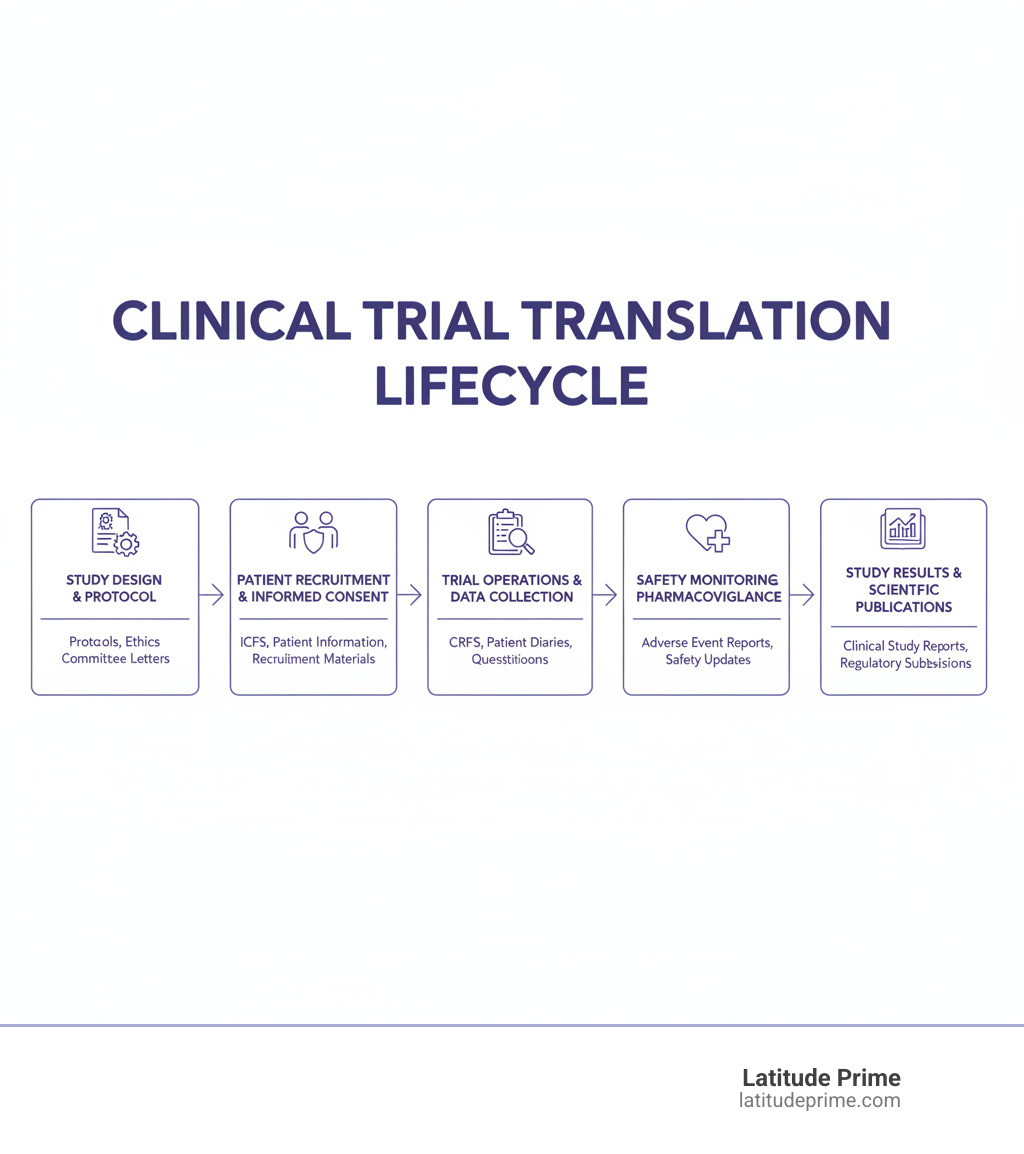
A clinical trial involves a wide range of documents needing translation. Informed Consent Forms (ICFs) are critical for ensuring patients understand the trial. Clinical protocols outline the study’s blueprint, while Investigator Brochures (IBs) compile all known information about the investigational product.
During the trial, Patient-Reported Outcomes (PROs) capture patient experiences, and Case Report Forms (CRFs) record all participant data. Adverse Event reports document any unfavorable occurrences. For regulatory submissions, drug labels and Clinical Study Reports (CSRs) are essential.
Patient-facing materials like recruitment brochures, educational guides, and mobile app interfaces also require translation that is not just accurate but accessible and culturally adapted. The list extends to contracts, quality of life measures, and the standardized Common Technical Document (CTD) modules for new drug applications.
Want to understand more about best practices for translating these diverse materials? Check out our complete guide to document translation.
A Deep Dive into Clinical Trial Translation Services
Running a global clinical trial requires a partner who understands that translating “Grade 3 hepatotoxicity” is not the same as translating a menu. Clinical trial translation services operate where medical expertise, regulatory knowledge, and linguistic precision intersect. Pharmaceutical companies, biotech firms, and CROs rely on specialists who understand the life sciences, not generalists.
For a broader look at how translation supports the entire life sciences ecosystem, visit: More info about life sciences services
Choosing Specialized Clinical Trial Translation Services vs. General Providers
Using a general translation agency for clinical trial documents is like using a butter knife for surgery. Specialized providers offer:
- Subject Matter Experts: Medical linguists, often with advanced degrees (Ph.D. or Master’s), who understand the science behind the words.
- Regulatory Knowledge: Deep familiarity with Good Clinical Practice (GCP), FDA, EMA, and other international standards.
- Terminology Management: Use of extensive, validated medical term databases (like MedDRA) to ensure absolute consistency.
- ISO-Certified Workflows: Processes like ISO 17100 and ISO 9001 guarantee systematic quality management.
As one clinical trial manager said, “With a specialized provider, I’ve never seen a ball being dropped… Just knowing that once I send a document, it will be picked up, go through the translation process, and always come back—that’s really a huge benefit.”
For more insights into why professional medical translation matters so much, check out: More info about professional medical translation
Key Service Types Explained
Professional services offer a menu of options for different needs:
- Standard Translation (TEP): A three-stage process of Translation, Editing, and Proofreading by multiple linguists to ensure accuracy.
- Back Translation: A safety check where a separate translator converts the text back to the source language to spot meaning shifts. Crucial for patient-facing materials.
- Linguistic Validation: A rigorous process for PROs to ensure conceptual equivalence across cultures, involving forward/back translation and cognitive debriefing.
- Cognitive Debriefing: Interviews with target patient populations to confirm that translated materials are clear and culturally appropriate.
- Harmonization: Ensures consistency when a document is translated into multiple languages.
- Certified Translation: A signed statement attesting to the translation’s accuracy, often required by regulatory authorities.
The Crucial Role of Localization and Cultural Adaptation
Translation gets the words right; localization gets the message right. Patient-facing materials must be adapted to the target population’s reading level (typically grade 6-8) and cultural context. Concepts of health, illness, and consent vary dramatically, and building trust requires culturally sensitive communication. This directly impacts patient recruitment and retention.
The approach differs by document type:
- Patient-Facing Materials (ICFs, PROs): Prioritize comprehension and trust. The style is simple and empathetic. Validation involves cognitive debriefing.
- Regulatory Documents (Protocols, IBs): Demand accuracy and compliance. The style is formal and precise. Validation relies on back translation and expert review.
Ensuring Quality, Compliance, and Consistency
In clinical trials, “good enough” is never acceptable. Every translated document must be accurate, compliant, and consistent. Regulatory bodies like the FDA, EMA, and the International Conference on Harmonisation (ICH) have established strict Good Clinical Practice (GCP) guidelines to protect participants and ensure data integrity. For example, the EU’s Clinical Trial Regulation requires patient-facing materials to be in every local language, demanding absolute consistency across all versions.

Essential Quality Standards and Certifications
Robust systems and certifications guarantee quality and security:
- ISO 17100:2015: The gold standard for translation services, ensuring a consistent, high-quality process.
- ISO 9001:2015: Demonstrates a commitment to quality management across all operations.
- HITRUST CSF & ISO 27001:2013: Certifications for data security, proving that confidential patient information is protected.
- HIPAA Compliance: Non-negotiable for U.S. trials, setting strict rules for handling patient health information.
Thorough linguist vetting and confidentiality agreements add further layers of protection. For more details on our commitment to quality, visit: More info about quality control
The Process for Clinical Trial Translation Services
A well-structured process ensures success:
- Initial Request & Analysis: You submit documents and requirements. The project team analyzes the content and complexity.
- Quote and Timeline: You receive a detailed quote and realistic timeline.
- Team Assignment: A project manager assembles a team of qualified medical linguists and subject matter experts.
- Translation and Review: A multi-step process including translation, editing by an independent linguist, and final proofreading.
- Back Translation & Reconciliation: For critical documents, a third linguist translates the text back to the source language to identify and fix any meaning discrepancies.
- Cognitive Debriefing: For patient-facing materials, members of the target patient population review the translation for clarity and cultural appropriateness.
- Client Review & Final Delivery: You review the materials before receiving the final, quality-assured translations.
Leading institutions like Johns Hopkins University School of Medicine require certified translation services for their clinical trial documents, underscoring the importance of a rigorous process. Example from a leading institution
Managing Consistency Across Multiple Languages
Achieving consistency across dozens of languages and documents requires specific tools and strategies:
- Translation Memory (TM): A database that stores previously translated segments, ensuring consistent phrasing and speeding up the process.
- Terminology Databases (TermBases): Centralized glossaries of approved medical and clinical terms to guarantee uniform terminology.
- Style Guides: Ensure consistent tone, formatting, and grammar across all documents.
- Centralized Platforms: Cloud-based systems that give all stakeholders real-time access to TMs, TermBases, and style guides for seamless collaboration.
Strategic Management of Translation in Global Trials
In a global clinical trial, translation is a strategic pillar that influences patient recruitment, operational efficiency, and speed to market. Leading pharmaceutical companies and CROs treat translation as a core function, not an afterthought, to coordinate sites, recruit diverse populations, and manage simultaneous regulatory submissions.

The Role of Technology and AI
Technology is amplifying human expertise in clinical trial translation services. Neural Machine Translation (NMT) produces fluent initial drafts, which are then perfected by human experts in a process called Machine Translation Post-Editing (MTPE). This can accelerate turnaround times by up to 40% on smaller projects.
Cloud-based translation management platforms centralize project assets like Translation Memories and glossaries, enabling real-time collaboration. As trials become more digital with mobile apps and wearable devices, API integrations allow translation platforms to connect directly with clinical trial systems for seamless linguistic support.
For more on how AI is changing the translation landscape, check out our guide on AI-powered MTPE services.
Managing Costs and Timelines Effectively
With drug development costs exceeding $500 million, efficiency is key. The most effective strategy is early planning: integrating translation needs from the start avoids rush fees and ensures consistency. Leveraging technology like Translation Memory maximizes the reuse of previously translated content, reducing both costs and timelines. Partnering with a single provider for large-scale trials can also lead to volume discounts and a deeper understanding of your project’s specific needs. Finally, strategically prioritizing service levels—using full linguistic validation for an ICF but MTPE for an internal training manual—invests your budget where it matters most.
Translating for Different Research Stages
Translation needs evolve with the trial:
- Early-Stage (Preclinical, Phase I): Focus is on a small set of highly technical documents like protocols and investigator brochures. Scientific precision is paramount.
- Late-Stage (Phase II, III): Translation volume explodes with global expansion. Patient-facing materials require cultural adaptation and linguistic validation, while CRFs and safety reports multiply.
- Post-Market (Phase IV): The focus shifts to pharmacovigilance, requiring rapid translation of adverse event reports. Patient support and marketing materials also need culturally sensitive adaptation.
A specialized partner understands these shifting demands and can scale support accordingly.
Frequently Asked Questions about Clinical Trial Translation
Here are answers to some of the most common questions we receive about specialized clinical trial translation services.
What is back translation and when is it necessary?
Back translation is a quality control step. After a document is translated (e.g., from English to Japanese), a second, independent translator translates it back into English without seeing the original. Comparing the back-translation to the source text reveals any shifts in meaning or nuance.
It is necessary for high-risk documents where precision is non-negotiable. This includes Informed Consent Forms (ICFs), Patient-Reported Outcomes (PROs), and other clinical outcome assessments. Regulatory bodies like IRBs or the FDA often require it to verify translation accuracy.
How do you ensure the confidentiality of sensitive clinical trial data?
Protecting your data is a top priority. We use multiple layers of security, including secure, encrypted file transfers and firewalls. Every team member signs a strict non-disclosure agreement, and access to data is limited on a need-to-know basis.
Our commitment is validated by industry-leading certifications. Latitude Prime is HITRUST CSF certified for healthcare data, ISO 27001 certified for information security management, and HIPAA-compliant. These certifications represent rigorous, audited standards for data protection.
What is the difference between translation and linguistic validation?
Translation is the process of accurately converting text from one language to another, preserving its meaning and tone. It’s used for documents like clinical protocols or investigator brochures.
Linguistic validation is a more extensive process used for instruments that collect data directly from patients, like PRO questionnaires. Its goal is to ensure the translated instrument is conceptually equivalent and measures the exact same thing as the original across different cultures. The process includes forward and back translations, expert review, and cognitive debriefing, where we interview target patients to confirm their understanding of the questions. In short, translation ensures accurate language, while linguistic validation ensures accurate measurement.
Conclusion
In global clinical trials, clear and accurate communication is the bedrock of success. Clinical trial translation services are essential for protecting patients, ensuring data integrity, and meeting complex regulatory demands. A single mistranslation can compromise years of research.
This is why a specialized partner is crucial. You need medical linguists, subject matter experts, and ISO-certified processes. You need a team that combines human expertise with technology like AI-powered MTPE to deliver quality results on time. Consistency across languages and documents isn’t just good practice—your trial’s success.
At Latitude Prime, we are that specialized partner. With our ISO-certified quality management system and network of linguists in over 300 languages, we understand what’s at stake. We manage the linguistic complexities so you can focus on what you do best: advancing medical science.
Ready to ensure your clinical trials communicate effectively across the globe? Get a free quote for your medical and healthcare translation needs
