
German to English Medical Translation 2025: Precise
The Critical Importance of Accurate Medical Translation
German to English medical translation converts critical healthcare documents – like patient records, clinical trial protocols, and medical device manuals – from German into English with precision and regulatory compliance. Here’s a quick overview:
- Who needs it: Patients, healthcare providers, pharmaceutical companies, medical device manufacturers, researchers, and regulatory bodies
- Common documents: Medical records, clinical trial documents, IFUs (Instructions for Use), informed consent forms, drug inserts, patient information leaflets, regulatory submissions
- Key requirements: Subject matter expertise, native-level fluency, ISO certifications (9001:2015, 13485:2016), HIPAA/GDPR compliance, and rigorous quality control
- Typical cost: $25-$40 per page for certified translations; $0.10-$0.12 per word for standard projects
- Turnaround time: 24-48 hours for short documents (1-3 pages); longer for complex clinical or regulatory materials
In healthcare, where clear communication is crucial, linguistic misunderstandings can have fatal consequences. A mistranslated dosage, an unclear surgical instruction, or a misunderstood patient history can lead to misdiagnosis, improper treatment, or even death. This is why accurate German to English medical translation demands more than bilingual fluency; it requires deep medical knowledge, cultural sensitivity, and strict adherence to international quality standards like ISO 13485 and data protection regulations like HIPAA and GDPR.
The stakes are particularly high, as Germany’s healthcare system produces millions of pages of medical documentation annually. These documents, from patient records to clinical trial data, must be translated with absolute precision for international use. A single error in translating a German compound medical term like Nierenbeckenentzündung (pyelonephritis) or a false friend like Gift (poison, not “gift”) can derail treatment plans or compromise patient safety.
With over 100 million German speakers worldwide, it is Europe’s second most spoken language. As the official language of Germany, Austria, and Liechtenstein, and with a significant role in Switzerland and Luxembourg, its broad geographic footprint makes German to English medical translation essential for international clinical trials, cross-border patient care, medical device distribution under EU MDR (Medical Device Regulation), and pharmaceutical market expansion.
I’m William Kennedy, a Translation Project Manager with over 8,500 language projects completed in four years. I’ve seen how critical precision is in German to English medical translation – from complex clinical trial documentation to patient-facing materials. My experience managing multilingual medical projects has taught me that the right translation partner can mean the difference between regulatory approval and costly delays, or even between effective treatment and patient harm.
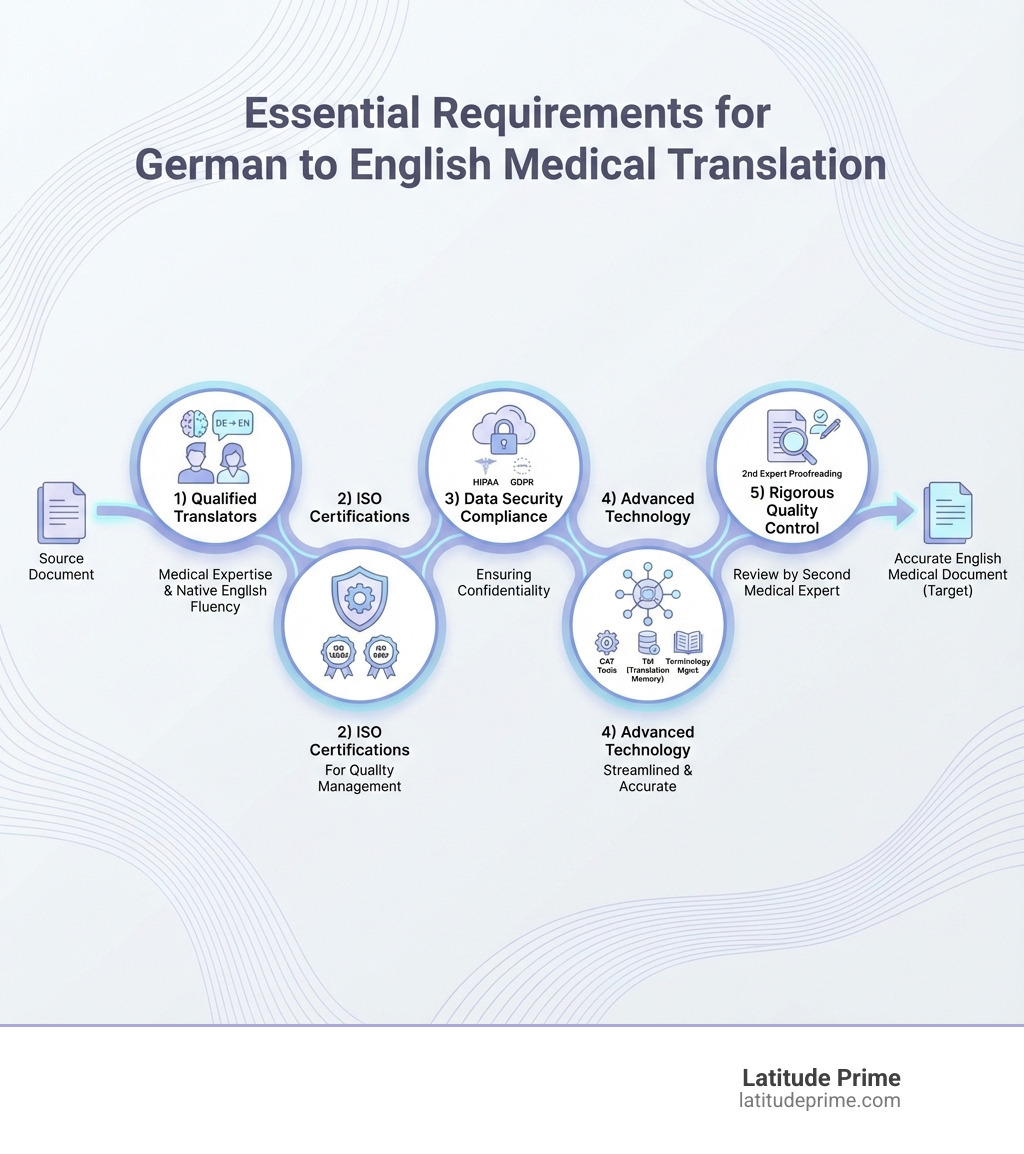
German to English medical translation terms made easy:
Why Precision is Non-Negotiable
Precision in German to English medical translation is not just a nicety; it is a fundamental requirement that directly impacts patient outcomes, legal implications, and the integrity of the healthcare ecosystem. Even a seemingly minor error can have severe consequences, such as a misdiagnosis from an inaccurately translated symptom or an incorrect dosage from a prescription typo. These are real dangers that underscore why precision is non-negotiable.
For pharmaceutical companies, inaccurate translations can lead to massive liabilities. Drug inserts, clinical trial protocols, and regulatory submissions must be flawlessly translated to ensure patient safety and compliance with international laws. The concept of informed consent, where patients grant permission for treatment or research after understanding all risks, is entirely dependent on accurate and clear translation. If a patient does not fully understand what they are consenting to, it violates their rights and can lead to legal challenges.
Medical device safety is another critical area. User manuals, safety labels, and regulatory documentation for medical devices must be translated with absolute accuracy, especially with regulations like the EU Medical Device Regulation (MDR) requiring extensive multilingual content. A poorly translated instruction for use could lead to device misuse and patient injury. For this reason, we emphasize that Translators in Healthcare must possess specialized expertise.
Who Relies on Flawless Translations?
A wide array of individuals and organizations rely on flawless German to English medical translation. At the heart of it are patients seeking treatment abroad, relocating, or participating in international clinical trials; their medical history, diagnoses, and treatment plans must be perfectly understood by English-speaking healthcare providers.
Healthcare providers, including doctors and nurses, depend on accurate translations to deliver effective care. They need to understand patient histories and diagnostic reports to make informed decisions. Medical researchers require precise translations of scientific articles and clinical study results to advance global medical knowledge.
Pharmaceutical companies and medical device manufacturers operate in a globalized market where accurate translations are vital for product registration, marketing, and user safety. Regulatory bodies demand meticulous translations to approve new drugs or devices. Even insurance companies rely on translated medical records to process claims for international patients. Our Medical Healthcare Translation & Interpretation Services cater to all these critical needs.
The Complexities of German to English Medical Translation

Translating medical documents from German to English is far from a simple linguistic exchange. It is a process with specific challenges that demand a translator’s profound expertise in both languages and medical fields.
One of the most immediate problems is linguistic nuance. German is known for its precision and often uses specific terminology that lacks a direct, single-word equivalent in English. Then there are the German compound words, which combine multiple nouns or adjectives into one long, descriptive medical term. Take Nierenbeckenentzündung, for instance. This single German word translates to “pyelonephritis” but literally breaks down to “kidney-pelvis-inflammation.” Understanding the components is crucial for accurate translation.
False friends are another linguistic trap: words that look or sound similar in German and English but have entirely different meanings. The classic example is Gift, which means “poison” in German, not a present. Imagine the confusion if a medical report mentions Gift and it is mistranslated.
Medical abbreviations and acronyms also pose a significant challenge. German and English medicine use a large number of abbreviations that often differ. An abbreviation common in a German hospital might be unknown or mean something different in an American clinic. Translators must be adept at recognizing these and finding their correct English equivalents.
While less prevalent in formal medical texts, dialectal variations can occasionally appear in patient-reported symptoms or informal notes, requiring a translator to recognize regionalisms. Finally, eponyms, medical terms named after people (e.g., Alzheimer’s disease), generally remain consistent, but their context might vary culturally. Navigating these complexities requires not just linguistic skill, but also deep medical knowledge and cultural sensitivity.
Common Documents Requiring Translation
The scope of documents that frequently require German to English medical translation is vast, covering nearly every aspect of healthcare, research, and regulatory compliance. We regularly handle a comprehensive range of materials to ensure seamless communication across borders.
Here’s a list of common medical documents we translate:
- Patient records: This includes medical histories, discharge summaries, laboratory results, imaging reports, and physician’s notes. Accurate translation is vital for continuity of care.
- Clinical trial documents: Protocols, investigator brochures, case report forms (CRFs), and study results are all critical for international clinical research.
- Informed Consent Forms (ICFs): These legally binding documents ensure patients understand the risks and benefits of a procedure or trial. Their precise translation is paramount.
- Instructions for Use (IFUs): Essential for medical devices, IFUs provide critical information on how to safely and effectively operate equipment.
- Medical device manuals: From installation guides to maintenance instructions, these ensure proper functioning and safety of medical technology.
- Pharmaceutical leaflets and drug inserts: These provide detailed information about medications, including dosage and side effects.
- Medical reports: Comprehensive reports from specialists, pathologists, or other medical practitioners.
- Scientific articles and research papers: For dissemination of medical knowledge and collaboration among international researchers.
Each of these document types demands linguistic accuracy and a deep understanding of medical terminology and regulatory requirements. Our Document Translation services are custom to meet these high standards.
The Role of Cultural Context
Beyond linguistic intricacies, cultural context plays a significant, often underestimated, role in German to English medical translation, especially in patient communication. Effective communication is not just about words; it is about conveying meaning in a way that resonates with the audience’s cultural background.
Consider patient communication styles. German culture often values directness and formality in medical settings. Patients may expect a more authoritative tone from doctors, and their expressions of pain might differ from those in English-speaking cultures. Translating patient education materials requires adapting not just the language but also the tone to ensure the message is received as intended.
The doctor-patient relationship can also vary. In some German-speaking contexts, there might be a more paternalistic approach, while many English-speaking countries emphasize patient autonomy. Translating discussions around treatment options needs to reflect these differing dynamics to avoid misunderstandings.
Perceptions of health and illness are deeply cultural. What constitutes a “serious” illness or attitudes towards mental health can differ. A translator must be sensitive to these underlying cultural frameworks to accurately convey a patient’s concerns or a doctor’s advice.
Even sensitive topics like end-of-life care discussions are heavily influenced by cultural norms. Translating advance directives or discussions about palliative care requires immense sensitivity to ensure the patient’s wishes are respected. This is where the expertise of Interpreter Services for Healthcare becomes invaluable, as they can bridge these cultural gaps in real time. A skilled medical translator must possess this same cultural acumen to produce translations that are not just accurate, but also appropriate and effective.
Hallmarks of a Qualified Medical Translator and Service
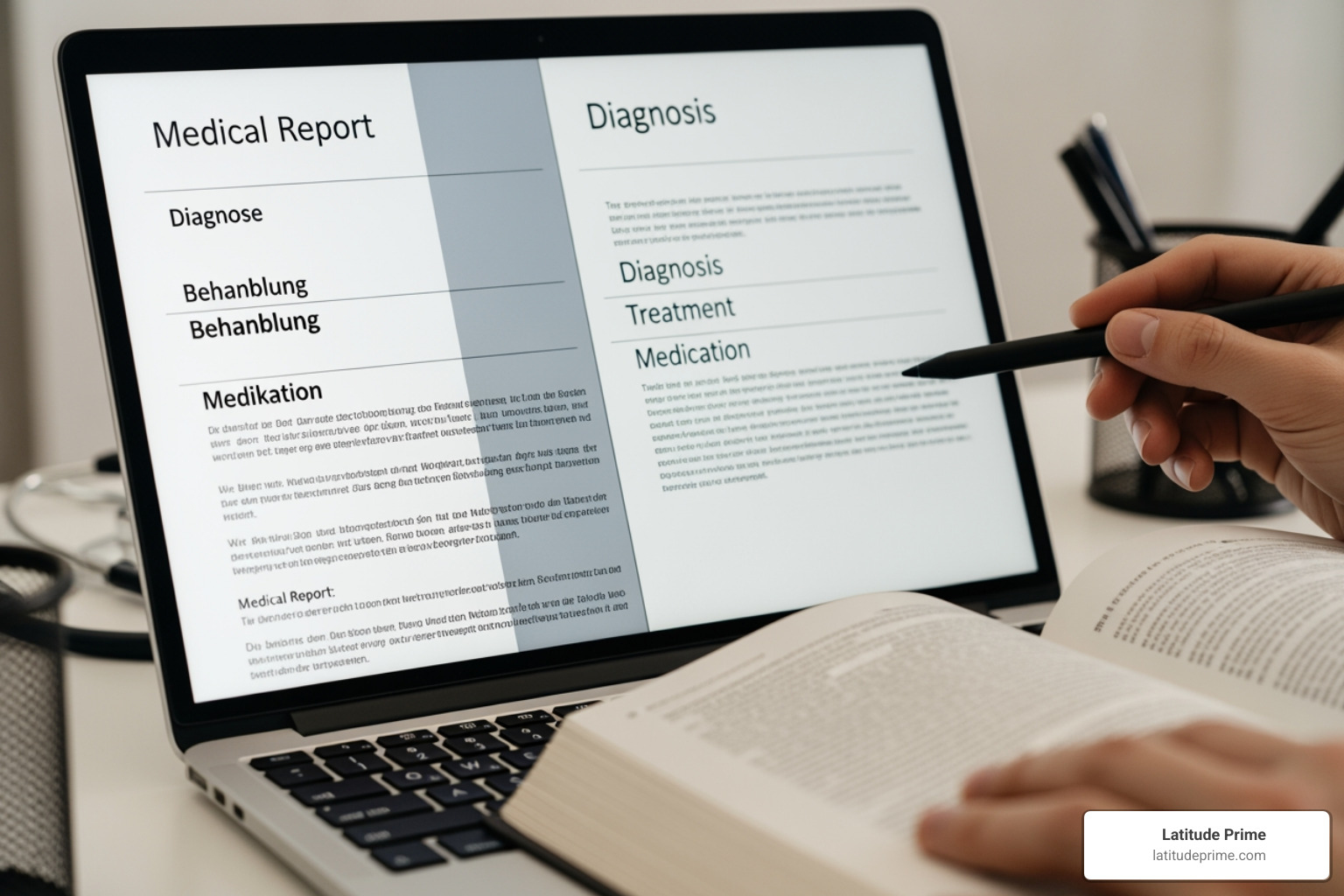
When it comes to German to English medical translation, the stakes are too high to compromise on quality. Identifying a truly qualified medical translator or service is paramount. The hallmarks of excellence go beyond linguistic proficiency to encompass specialized knowledge, adherence to rigorous standards, and a commitment to data security.
At the core is subject matter expertise. A medical translator is not just someone who speaks German and English; they are individuals with a deep understanding of medical science and terminology. This often means they have a background in healthcare or a related life science. Coupled with this is native-level fluency in both the source (German) and target (English) languages, ensuring correctness and nuance.
Professional certifications signal a translator’s commitment to their craft. Furthermore, a reputable translation service will operate under stringent Quality Management Systems (QMS), often evidenced by ISO certifications. Finally, given the sensitive nature of medical information, robust data security protocols like encryption and compliance with privacy regulations are non-negotiable.
Essential Qualifications for German to English Medical Translation
What truly sets an expert German to English medical translator apart? It is a combination of formal education, practical experience, and a commitment to ongoing professional development.
Many of our most qualified medical translators possess an advanced medical background, such as an MD or a PhD in a relevant life science discipline. This provides an invaluable understanding of complex concepts and terminology that a general linguist lacks. Beyond formal education, significant years of experience in medical translation are crucial. This practical experience hones their ability to handle diverse document types and steer nuanced medical jargon.
Our commitment to excellence is reflected in our corporate membership with the American Translators Association (Corporate Member: 272027). This affiliation signifies our adherence to the highest professional standards. Individual translators, too, should demonstrate membership in professional associations like the ATA, which requires adherence to strict professional codes of conduct ensuring ethical practices, confidentiality, and accuracy.
Finally, the medical field is constantly evolving with new research and terminology. Therefore, continuous professional development (CPD) is essential. Qualified medical translators regularly participate in workshops and specialized training to keep their knowledge current, ensuring they can accurately translate the latest medical advancements. This dedication ensures our Healthcare Professionals Translation services remain at the forefront.
Ensuring Accuracy and Regulatory Compliance
In German to English medical translation, accuracy is paramount, but it must go hand in hand with stringent regulatory compliance. This dual focus ensures the translation is not only linguistically correct but also meets the legal and ethical requirements of the healthcare industry.
Leading translation services in the medical field often hold specialized certifications. ISO 13485 certification is for quality management systems in medical devices, demonstrating a commitment to meeting regulatory requirements. ISO 9001 certification is a broader standard for quality management systems, ensuring consistent quality. These certifications represent a rigorous framework for quality control.
Beyond these, strict adherence to data privacy regulations is critical. HIPAA compliance (Health Insurance Portability and Accountability Act) is essential for handling protected health information (PHI) in the United States. Similarly, GDPR compliance (General Data Protection Regulation) is crucial for any data originating from the European Union, including Germany. We implement secure protocols, including encryption and strict access controls, to safeguard sensitive medical data.
To further guarantee accuracy, a robust quality assurance process is indispensable. This typically involves in-context linguistic validation, where the translated text is reviewed within its intended layout. Crucially, every medical translation undergoes proofreading by a second expert. This independent review by another qualified medical translator catches potential errors, providing an essential layer of quality control. This multi-layered approach ensures our translations are accurate and compliant.
Navigating the Translation Process: From Technology to Vetting
Starting a German to English medical translation project requires careful navigation, from selecting the right provider to understanding the translation workflow. Our goal is to make this process as transparent and efficient as possible for you.
The first step is choosing a provider that aligns with your needs and quality expectations. This involves looking beyond basic language services to find specialists in medical translation. Once a partner is identified, the next step is requesting a quote to understand the potential costs and timelines. We encourage you to Get a Free Quote from us to experience our transparent pricing and responsive service.
Understanding the project workflow is also important. A professional service typically involves multiple stages: document analysis, terminology extraction, translation by a subject-matter expert, editing by a second expert, quality assurance, and final delivery. Turnaround times vary based on the document’s length, complexity, and urgency. A short document (1-3 pages) might be completed in 24-48 hours, while extensive clinical trial documentation will require more time. Cost factors are influenced by word count, document type, expertise, urgency, and additional services like certification.
The Role of Technology in German to English Medical Translation
Technology has revolutionized the translation industry, and German to English medical translation is no exception. However, its role is primarily to improve human expertise, not replace it, especially in such a critical field.
Computer-Assisted Translation (CAT) tools are indispensable. These programs assist human translators by providing a structured environment, ensuring consistency, and improving efficiency. Key components include Translation Memory (TM), which stores previously translated segments to ensure consistency, and Terminology Management (TermBases), which are glossaries of approved medical terms.
The rise of AI and Machine Translation Post-Editing (MTPE) has also impacted medical translation. AI-powered engines can provide an initial base translation, which is then carefully reviewed and refined by a human medical translator in a process called Post-Editing (MTPE). This hybrid approach can speed up the process for suitable content while ensuring human-level accuracy.
However, it is crucial to acknowledge the limitations of AI in medical translation. While AI can handle repetitive phrases, it struggles with nuance, cultural context, and the critical understanding required for medical diagnosis. Machine translation lacks the ability to critically assess context or apply the judgment necessary to ensure patient safety. For real-time language needs, even technologies like Video Remote Interpreting Healthcare rely on skilled human interpreters. Technology is a powerful assistant, but the human medical translator remains the ultimate guardian of accuracy.
How to Vet a Reliable Translation Service
Finding a truly reliable German to English medical translation service requires a discerning eye. Given the critical nature of medical content, perform thorough due diligence.
First, check for ISO certifications. As discussed, ISO 9001 and especially ISO 13485 (for medical devices) indicate a commitment to rigorous quality management systems and internationally recognized standards.
Next, ask for translator qualifications. A reputable service will be transparent about the expertise of their linguists. They should be able to confirm that their German medical translators have relevant medical backgrounds, experience, and professional certifications. Inquire about their vetting process for new translators.
Review case studies or testimonials, particularly those related to medical projects. This provides real-world evidence of their capabilities. Our services have been trusted by leading companies in pharmaceutical, medical device, and healthcare industries globally.
Data security is paramount. Therefore, inquire about data security protocols, such as SOC 2 Type II compliance, which demonstrates a commitment to managing customer data securely. This ensures sensitive patient information is protected.
Finally, for larger projects, request a sample translation. This allows you to assess the quality of their work before committing. It is a practical way to evaluate their linguistic accuracy and medical terminology expertise. Choosing a translation partner is a decision that impacts patient safety and business success, and our About Us page highlights our commitment to these standards.
Frequently Asked Questions about German Medical Translation
When navigating German to English medical translation, many questions often arise. Here, we address some of the most common inquiries to help you make informed decisions.
What is a certified translation and when do I need one?
A certified translation is a word-for-word translation accompanied by a signed statement of accuracy from the translator or translation company. This statement attests that the translation is complete and accurate to the best of the translator’s knowledge.
You typically need a certified translation for official purposes where legal or governmental bodies require assurance of the translation’s accuracy. This is often the case for medical records submitted to entities like courts, universities, or government agencies like USCIS for immigration purposes. Examples include medical records for visa applications, asylum requests, or academic admissions. While services may offer notarization or an e-apostille for specific international requirements, the certified translation is the core of an official submission.
How much does German medical translation cost?
The cost of German to English medical translation varies based on the document’s length, complexity, and urgency.
For certified translations, pricing is often per page (typically 250 words or less), with rates from $25 to $40 per page. For standard, non-certified projects, pricing is more commonly per word, with rates generally between $0.10 and $0.12 per word.
Additional services can also impact the cost. Expedited services often incur a surcharge, sometimes as much as 50% of the base fee. Other add-ons like proofreading, notarization, or obtaining an e-apostille will also add to the final price. For a precise estimate, we always recommend getting a detailed quote.
What is the typical turnaround time?
The turnaround time for German to English medical translation depends on the document’s volume and complexity.
For shorter documents, such as a single medical record or a brief physician’s note (typically 1-3 pages or up to 750 words), digital delivery can often be completed within 24 to 48 hours.
However, for larger and more complex projects, such as extensive clinical trial documentation or regulatory submissions, the turnaround time will be significantly longer. These projects involve multiple stages that cannot be rushed without compromising accuracy. A timeline might span several business days or even weeks, depending on the total word count. If you have a critical deadline, inquiring about expedited services is advisable.
Conclusion: Ensuring Clarity and Safety in Healthcare
The journey from a German medical document to its accurate English counterpart is complex, involving linguistic challenges, cultural nuances, and stringent regulatory demands. We have explored how German’s compound words, false friends, and unique abbreviations can trip up an inexperienced translator, highlighting why precision is essential. The implications of inaccurate German to English medical translation are profound, ranging from misdiagnosis and ineffective treatment to legal repercussions and compromised patient safety.
This is why professional expertise cannot be overstated. A qualified medical translator is not merely bilingual; they possess a deep understanding of medical science, adhere to strict professional codes, and commit to continuous learning. Backed by robust Quality Management Systems, ISO certifications (like 9001 and 13485), and compliance with data privacy regulations such as HIPAA and GDPR, these experts ensure every translated word contributes to clarity and safety in healthcare.
The life-saving impact of accuracy in medical translation is undeniable. It ensures that patients receive the right care, researchers can collaborate effectively, and medical innovations can reach global markets safely. At Latitude Prime, we are dedicated to providing these critical services, blending human expertise with advanced technology to deliver translations that meet the highest standards of quality and compliance. For expert language solutions that meet the highest standards of quality and compliance, explore our Medical Healthcare Translation & Interpretation Services.
