
translate to karen: Unlock 3 Steps to Accurate Translation
Understanding the Karen Language and Translation Landscape
Translate to karen requires understanding a complex family of languages spoken by the Karen people in Myanmar (Burma) and Thailand. Here’s what you need to know:
Quick Guide to Karen Translation:
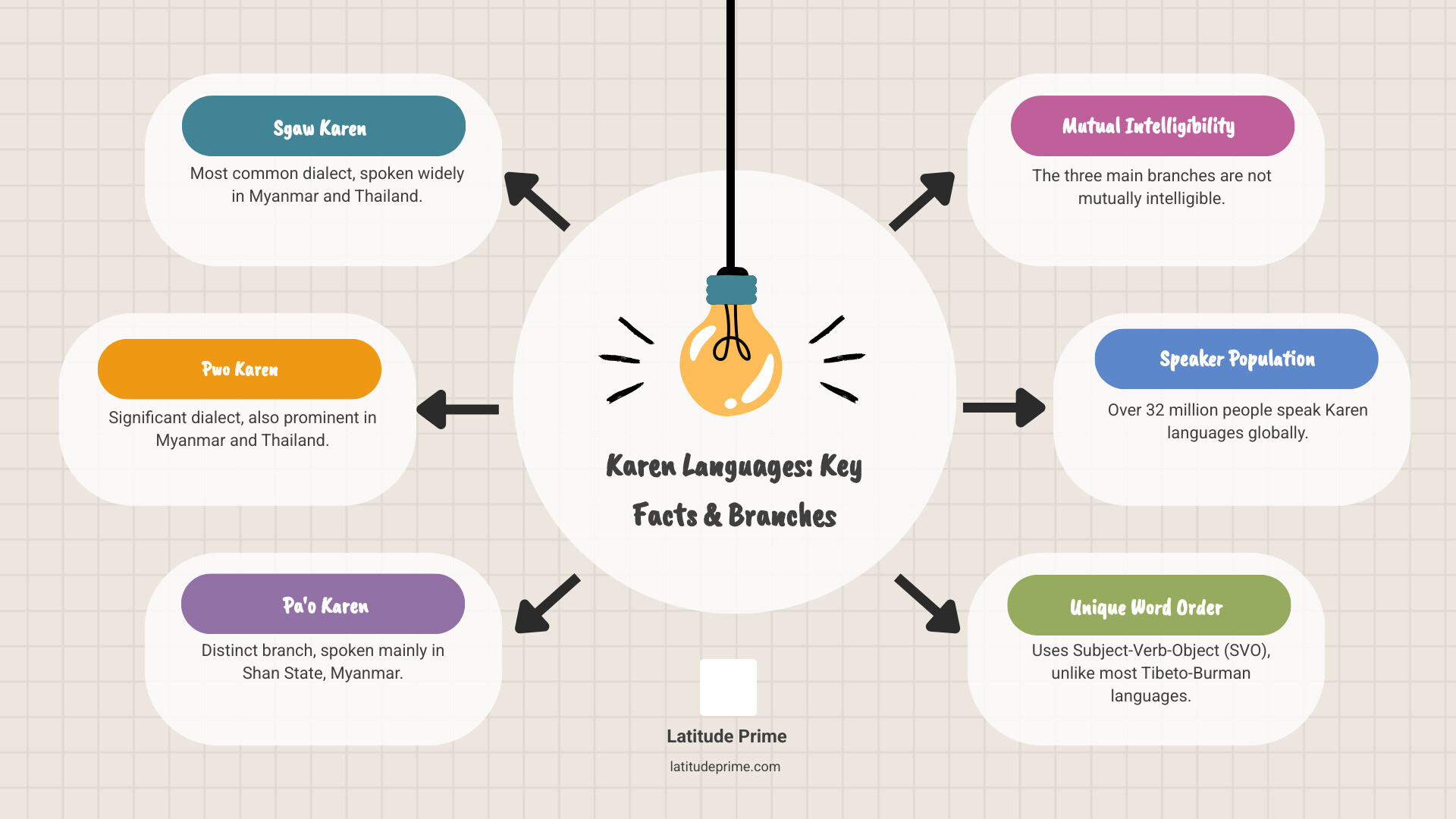
- Language Family: Part of the Tibeto-Burman group within the Sino-Tibetan language family
- Main Dialects: Sgaw Karen (most common), Pwo Karen, and Pa’o Karen
- Mutual Intelligibility: These three branches are not mutually intelligible
- Speakers: Over 32 million people speak Karen languages
- Unique Feature: Uses Subject-Verb-Object (SVO) word order, almost unique among Tibeto-Burman languages
- Professional Services: Essential for legal, medical, and official documents due to dialect complexity and cultural nuances
The Karen languages present unique challenges for translation. Unlike most Tibeto-Burman languages that follow a Subject-Object-Verb pattern, Karen languages use SVO word order similar to English. However, this doesn’t make translation straightforward. The three main branches—Sgaw, Pwo, and Pa’o—differ significantly in vocabulary and grammar, meaning a translator specializing in one dialect may not be able to work with another.
Professional translation is critical for Karen language work. Machine translation tools currently focus primarily on S’gaw Karen and struggle with the tonal nature of the language, cultural idioms, and formal contexts. For immigration documents, medical forms, legal paperwork, and business communications, human translators who are native speakers provide the accuracy and cultural sensitivity required.
As William Kennedy, a Project Manager with over a decade of translation experience overseeing 8,500+ language projects, I’ve seen how essential it is to translate to karen with the right expertise and cultural understanding. This guide will walk you through the process of finding reliable Karen translation solutions for your specific needs.
Understanding the Nuances of Karen

To truly understand how to translate to karen effectively, we must first appreciate its unique linguistic characteristics. The Karen languages are a fascinating group within the Tibeto-Burman branch of the Sino-Tibetan language family, primarily spoken by the Karen ethnic group residing in Myanmar and Thailand. This section will detail the linguistic specifics crucial for accurate translation, highlighting why a nuanced approach is always best.
The Main Branches: Sgaw, Pwo, and Pa’o
The Karen language family is not a monolithic entity; rather, it comprises several distinct branches, with Sgaw, Pwo, and Pa’o being the three most prominent. These are not merely dialects in the casual sense but are often considered separate languages due to significant differences.
Key Differences Between the Main Karen Language Branches:
- Sgaw Karen: This is arguably the most widely spoken and recognized variant, particularly in refugee communities worldwide, including in our own United States cities like Minneapolis. Many online translation tools, if they support Karen at all, tend to focus on Sgaw. It has its own distinct script and a rich literary tradition.
- Pwo Karen: While also widely spoken, Pwo Karen has notable differences in vocabulary, grammar, and pronunciation compared to Sgaw. It’s often found in different geographic regions within Myanmar and Thailand, leading to distinct cultural expressions.
- Pa’o Karen: Distinct from both Sgaw and Pwo, Pa’o Karen speakers often have their own unique cultural practices and a separate script. Linguistic variations are significant, making communication between a Pa’o speaker and a Sgaw or Pwo speaker challenging without a common language or interpreter.
The crucial point here is that these three main branches are not considered to be mutually intelligible. This means that a speaker of Sgaw Karen would likely not understand a speaker of Pwo Karen, and vice versa, without prior exposure or learning. This lack of mutual intelligibility poses a significant challenge for translation. When you need to translate to karen, specifying the exact dialect is paramount. A translator fluent in Sgaw Karen might not be able to accurately translate a document written in Pwo Karen, much like a Spanish speaker might struggle with Portuguese, despite both being Romance languages. This necessitates a careful approach to ensure we match your project with a linguist proficient in the specific Karen variant required.
Unique Grammar and Structure
Beyond dialectal variations, Karen languages possess a grammatical structure that sets them apart, even within their own language family.
One of the most striking features of Karen languages is their Subject-Verb-Object (SVO) word order. This might not sound to English speakers, as English also follows an SVO structure. However, it is almost unique among Tibeto-Burman languages, which typically adhere to a Subject-Object-Verb (SOV) word order. This distinct characteristic can sometimes make the initial learning curve slightly less steep for English speakers, but it doesn’t diminish the overall complexity.
Furthermore, Karen languages are tonal languages. This means that the meaning of a word can change entirely based on the pitch contour used when speaking it. For example, the same sequence of sounds, pronounced with a rising tone versus a falling tone, could convey two completely different ideas. This tonal aspect is incredibly difficult for machine translation tools to grasp and replicate accurately, often leading to humorous or, more critically, gravely incorrect translations. Our professional linguists, being native speakers, inherently understand and apply these tonal nuances, which is vital for both spoken and written communication where tone can be implied.
Finally, the cultural context, idioms, and expressions woven into Karen languages are rich and complex. Direct, word-for-word translation often fails to capture the true meaning or cultural appropriateness. Imagine trying to explain an English idiom like “raining cats and dogs” literally to someone unfamiliar with it – it would be confusing! Karen languages have their own unique set of cultural references, proverbs, and figures of speech that require deep cultural understanding to translate accurately and appropriately. This is where the human element of translation truly shines, ensuring that your message resonates as intended with the Karen audience.
How to Translate to Karen: A Step-by-Step Guide

When it comes to the intricate task of “how to translate to karen,” a methodical approach is key. This section provides actionable steps and highlights the importance of expert translation to ensure your message is not just translated, but truly understood.
Step 1: Assess Your Translation Needs
Before starting on any translation project, the first and most crucial step is to clearly define what you need. This assessment will guide your choices and help us provide you with the most effective solution.
- Document Type: What kind of material do you need translated? Is it a legal document like an immigration form or a birth certificate? Perhaps it’s a medical record, a technical manual, educational materials for students, or marketing content for a business initiative. Different document types require different levels of specialized knowledge and terminology.
- Purpose (Legal, Medical, Personal): Why are you translating this document? Is it for official submission to a government agency (like USCIS), for healthcare communication between a doctor and patient, for an educational institution, or for personal understanding? The purpose dictates the required level of accuracy, certification, and formality.
- Target Audience: Who will be reading this translation? Is it for a broad community, specific individuals, or a professional audience? Understanding your audience helps tailor the tone and style of the translation.
- Formality Level: Do you need a formal, official translation, or is a more conversational, informal tone acceptable? This is particularly relevant in languages like Karen where cultural nuances heavily influence communication styles.
- Urgency: What is your deadline? While we pride ourselves on efficient delivery, highly urgent projects may require expedited services, which we are equipped to handle.
By clearly outlining these aspects, you provide us with the necessary information to accurately scope your project and assign the most suitable expert linguists from our network in Minneapolis, Washington D.C., San Diego, Miami, Fort Lauderdale, and beyond.
Step 2: Choosing the Right Translation Solution
Once you’ve assessed your needs, the next step is to choose the translation solution that best fits your requirements. For translate to karen, especially for important or official documents, professional human translation is almost always the superior choice over machine translation tools.
| Feature | Machine Translation (AI Tools) | Professional Human Translation (Latitude Prime) |
|---|---|---|
| Accuracy | Basic gist, often inaccurate with nuances, idioms, tone | High accuracy, culturally appropriate, contextually relevant |
| Cultural Nuance | Lacks understanding of cultural context, can be insensitive | Deep cultural understanding, preserves idioms and expressions |
| Dialect Support | Primarily Sgaw Karen, struggles with other dialects | Supports specific Karen dialects (Sgaw, Pwo, Pa’o) as requested |
| Quality | Varies widely, often requires heavy post-editing | Rigorous quality assurance, editing, and proofreading by a second linguist |
| Specialization | Limited to general text, struggles with technical/legal jargon | Expert linguists in various industries (medical, legal, technical) |
| Certification | Not available | Available for official use |
| Confidentiality | Data privacy concerns | Strict confidentiality protocols, secure handling of sensitive documents |
While free online tools like Google Translate or AI-powered “Karen translators” can give you a rough idea of a text’s meaning, they are simply not reliable for critical documents. They struggle immensely with the tonal nature of Karen languages, the lack of mutual intelligibility between dialects, and the deep cultural context required for accurate communication. We’ve seen the headaches (and sometimes hilarity) that can arise from relying solely on machine translation for complex linguistic tasks.
For any significant project, especially those involving legal, medical, or official communications, we strongly recommend professional linguists. Our team comprises native speakers who work exclusively in their mother tongue and within their field of expertise. This ensures that your translation is not only linguistically correct but also culturally appropriate and accurate in its specialized terminology.
More info about our translation services
Step 3: Review and Verification
The translation process doesn’t end with the initial rendering of text. A crucial step, particularly for professional services, is the review and verification phase. This is where we ensure the highest quality output for your Karen translation.
Our standard practice at Latitude Prime, aligned with our ISO-certified quality management system, involves a multi-step process:
- Initial Translation: Completed by a qualified native Karen speaker.
- Editing and Proofreading: A second professional linguist, also a native Karen speaker, carefully reviews the translation. This step catches any errors, refines word choice, and ensures consistency and adherence to terminology. This comprehensive review is a cornerstone of our commitment to accuracy.
- Client Review (Optional but Recommended): For highly sensitive or specialized documents, we often recommend that clients have a native Karen speaker from their side review the translated text, especially if there are very specific internal terminologies or stylistic preferences. This collaborative approach helps guarantee that the final product perfectly meets your expectations.
This rigorous quality assurance process is vital when you translate to karen, ensuring that every nuance, tone, and cultural implication is correctly conveyed. We believe in delivering translations that are not just accurate, but truly effective.
Working with Professional Karen Translators
When the stakes are high, relying on professional Karen translators is not just a preference, it’s a necessity. This section explains the undeniable benefits and the robust process involved in using professional services for your high-stakes Karen translation needs.
Why Professional Translation Matters
For us, professional translation is about much more than just converting words from one language to another; it’s about bridging cultures, ensuring clarity, and maintaining integrity. When you need to translate to karen, here’s why professional services, like ours, are indispensable:
- Accuracy Guarantee: Our ISO-certified quality management system means every project undergoes stringent checks. We use native-speaking linguists who are experts in the target language and subject matter, followed by independent editing and proofreading. This rigorous process virtually eliminates errors, providing you with a translation you can trust.
- Cultural Appropriateness: As discussed, Karen languages are rich in cultural context. A professional translator understands these nuances, ensuring that your message respects cultural sensitivities and resonates authentically with the audience. This avoids misinterpretations, which can be costly in business, legal, or medical contexts.
- Industry-Specific Terminology: Whether your document is medical, legal, technical, or financial, it contains specialized terminology. Our network includes linguists with expertise across diverse technical industries. They understand the precise jargon and concepts of your field, ensuring that complex information is translated accurately without losing its specific meaning.
- Confidentiality and Security: Professional services operate with strict confidentiality agreements and secure data handling protocols, crucial when dealing with sensitive information.
- Efficiency and Reliability: We provide consistent quality and meet deadlines, managing complex projects with multiple linguists and tight turnaround times.
More info about Karen Translation
How to Find a Reliable Service to Translate to Karen
Finding the right partner to translate to karen is crucial. With so many options available, here’s how we ensure you connect with reliable services:
- Vetting Translators: We employ a rigorous vetting process for our linguists. This means ensuring they are native speakers of the target Karen dialect (Sgaw, Pwo, or Pa’o) and possess certified linguistic qualifications. We also look for proven experience in specific fields.
- Native Speakers: This is non-negotiable for us. A native speaker possesses an innate understanding of the language’s subtleties, cultural context, and tonal variations that non-native speakers, no matter how proficient, might miss.
- Field Expertise: Your medical document needs a medical translator, your legal brief needs a legal translator. We match your project with a linguist who has demonstrable expertise in your specific industry. This ensures accurate terminology and contextual understanding.
- Quality Assurance Processes: Look for providers who detail their quality assurance steps, such as our multi-stage translation, editing, and proofreading process performed by separate linguists.
- Client Testimonials and Reputation: While we don’t mention competitors, we encourage you to seek out reputable language service providers who can demonstrate a track record of satisfied clients and expertise in diverse languages, including Karen.
When requesting a quote, be prepared to provide details on translator specialization, specific Karen dialect preferences, any design needs, and your deadlines. This information helps us provide you with a faster and more accurate estimate, ensuring your project to translate to karen is handled with precision from the outset.
Additional Services for Karen Language Needs
Our commitment to supporting the Karen community extends beyond just written translation. We offer a comprehensive suite of services designed to meet all your Karen language communication needs:
- Interpretation: For real-time spoken communication, we provide professional Karen interpreters. This includes:
- Consecutive Interpretation: Where the speaker pauses, and the interpreter conveys the message. Ideal for medical appointments, legal consultations, or parent-teacher conferences.
- Simultaneous Interpretation: Where the interpreter translates in real-time as the speaker talks, often used in conferences or large meetings.
- Telephonic Interpretation: Convenient for quick calls or when an on-site interpreter isn’t feasible.
- Transcription: We convert spoken Karen audio or video recordings into written text. This is invaluable for legal proceedings, interviews, research, or content creation.
- Voice-overs: For multimedia projects, we can provide professional Karen voice-over artists to narrate videos, e-learning modules, or advertisements, ensuring the message is delivered with appropriate tone and cultural resonance.
- Subtitling: We create accurate and culturally appropriate subtitles for video content, making your message accessible to Karen-speaking audiences.
- Website Localization: To effectively reach Karen communities online, we can localize your website content, adapting not just the language but also cultural elements, imagery, and user experience to be relevant and engaging. This is a cost-effective way to expand your reach.
- Multilingual Search Engine Optimization (SEO): For businesses targeting Karen-speaking markets, we offer multilingual SEO services to ensure your content ranks highly in search results for Karen-language queries.
Whether you need a document to translate to karen or require real-time communication support, our diverse range of services ensures that all your linguistic needs are met with the highest standards of professionalism and cultural understanding.
Frequently Asked Questions about Karen Translation
We understand that translating a less common language like Karen can raise many questions. Here, we address some of the most common inquiries we receive, drawing on our extensive experience.
What industries most commonly require you to translate to Karen?
Due to the significant Karen diaspora, particularly in regions like Minneapolis, Washington D.C., San Diego, Miami, and Fort Lauderdale, several key industries frequently require Karen translation services:
- Healthcare: This is a critical area. Hospitals, clinics, and individual practitioners often need to translate to karen patient forms, medical instructions, consent forms, and discharge papers to ensure effective communication and patient safety. Interpreters are also vital for doctor-patient consultations.
- Legal: Immigration services, law firms, and courts regularly require Karen translation for immigration documents (birth certificates, marriage licenses, asylum applications), legal briefs, court proceedings, and official paperwork. Certified translations are usually a must here.
- Social Services: Community organizations, government agencies, and non-profits often need to translate outreach materials, benefits information, housing applications, and social support documents to assist Karen families and individuals. Interpreters are also frequently requested for client meetings.
- Education: Schools and educational institutions frequently translate to karen parent communications, school policies, bilingual learning materials, and student support documents to facilitate engagement with Karen-speaking families and students.
- Business: As Karen communities grow, businesses may need to translate workplace instructions, employee handbooks, marketing materials, and internal communications to effectively engage Karen-speaking employees and customers.
What are the biggest challenges when you translate to Karen?
Translating to or from Karen presents unique problems that demand expert linguistic and cultural knowledge:
- Lack of Mutual Intelligibility: As discussed, the three main branches (Sgaw, Pwo, and Pa’o) are not mutually intelligible. This means that a translator must be proficient in the specific Karen dialect of your document or audience. Failing to identify the correct dialect is a common pitfall that can render a translation useless.
- Tonal Nature of the Language: Karen languages are tonal. Slight variations in pitch can completely alter a word’s meaning. This complexity is incredibly challenging for machine translation and requires a human ear and understanding to convey accurately, especially in spoken interpretation or voice-over work.
- Cultural Nuances and Idioms: Karen languages are rich with idioms, proverbs, and cultural expressions that have no direct equivalents in English. A literal translation would be confusing or meaningless. Professional translators adeptly steer these cultural intricacies, ensuring the translated message is culturally appropriate and retains its intended meaning and impact.
- Script Variations: Different Karen dialects may use distinct writing systems, adding another layer of complexity to translation and typesetting.
- Limited Resources: Compared to more widely spoken languages, there are fewer readily available linguistic resources (dictionaries, grammar guides) for Karen, making the expertise of native, professional linguists even more critical.
Can online tools accurately translate S’gaw Karen?
Online tools like Google Translate or various AI-powered “Karen translators” can provide a basic gist for S’gaw Karen, which is the most common dialect found online. However, we must stress that they are severely limited in their accuracy and reliability for anything beyond casual, non-critical understanding.
Here’s why they fall short:
- Complexity of Language: They struggle with the intricate grammar and especially the tonal nature of Karen languages.
- Dialectal Differences: While some tools may claim to support “Karen,” they almost exclusively focus on S’gaw. They cannot handle the significant vocabulary and grammatical differences present in Pwo, Pa’o, or other less common Karen variants.
- Cultural Nuances: AI and machine translation lack the cultural understanding to correctly interpret idioms, metaphors, and context-dependent phrases, often leading to awkward, nonsensical, or even offensive translations.
- Formal vs. Informal Language: They often fail to differentiate between formal and informal registers, which is crucial for professional or official documents.
- Lack of Quality Assurance: There’s no human review, editing, or proofreading process, meaning errors are rampant and uncorrected.
For these reasons, online tools are unsuitable for official, legal, medical, educational, or any important documents. For best results and to ensure your message is accurate, culturally appropriate, and serves its intended purpose, professional translation services with certified Karen linguists are not just recommended, they are essential. We’ve seen too many instances where relying on free tools has led to costly mistakes or serious misunderstandings.
Conclusion: Your Partner for Accurate Karen Translation
Navigating the complexities of the Karen language—with its distinct dialects, tonal nuances, and rich cultural context—requires more than just a dictionary or an automated tool. It demands the expertise, precision, and cultural sensitivity that only professional linguists can provide. Whether your needs involve legal documents, critical healthcare information, educational materials, or business communications, ensuring accurate and culturally appropriate translation is paramount.
At Latitude Prime, we are dedicated to providing unparalleled language services. Our commitment to quality is underpinned by our ISO-certified processes and an extensive network of expert linguists who are not only native speakers of various Karen dialects but also specialists in diverse technical industries. This means when you choose us, you’re choosing accuracy, reliability, and cultural fidelity.
We pride ourselves on being your trusted partner, offering comprehensive solutions from written translation and localization to interpretation, transcription, and voice-over services. Our teams in Minneapolis, Washington D.C., San Diego, Miami, and Fort Lauderdale are ready to assist you. For expert handling of all your Karen language needs, from legal documents to healthcare interpretation, contact our team at our Minneapolis translation office. Let us help you open up seamless communication and bridge linguistic gaps with confidence.
