Medical Translation Services: Affordable Excellence 2025
Why Medical Translation Services Are Essential for Patient Safety and Global Healthcare
Medical translation services are specialized language solutions that convert healthcare documents, pharmaceutical materials, and clinical content between languages while maintaining accuracy, regulatory compliance, and patient safety. These services go beyond basic translation—they require subject matter experts with medical backgrounds to ensure technical terminology is precise and culturally appropriate.
Key features of professional medical translation services include:
- Certified translators with medical or scientific degrees (doctors, nurses, pharmacists)
- ISO certifications (ISO 17100:2015, ISO 9001:2015, ISO 13485:2016 for medical devices)
- HIPAA-compliant processes to protect patient data and confidential information
- Multi-step quality control with dual-translator review and proofreading
- Specialized expertise across pharmaceuticals, clinical trials, medical devices, and regulatory submissions
- Terminology management to ensure consistency across all translated materials
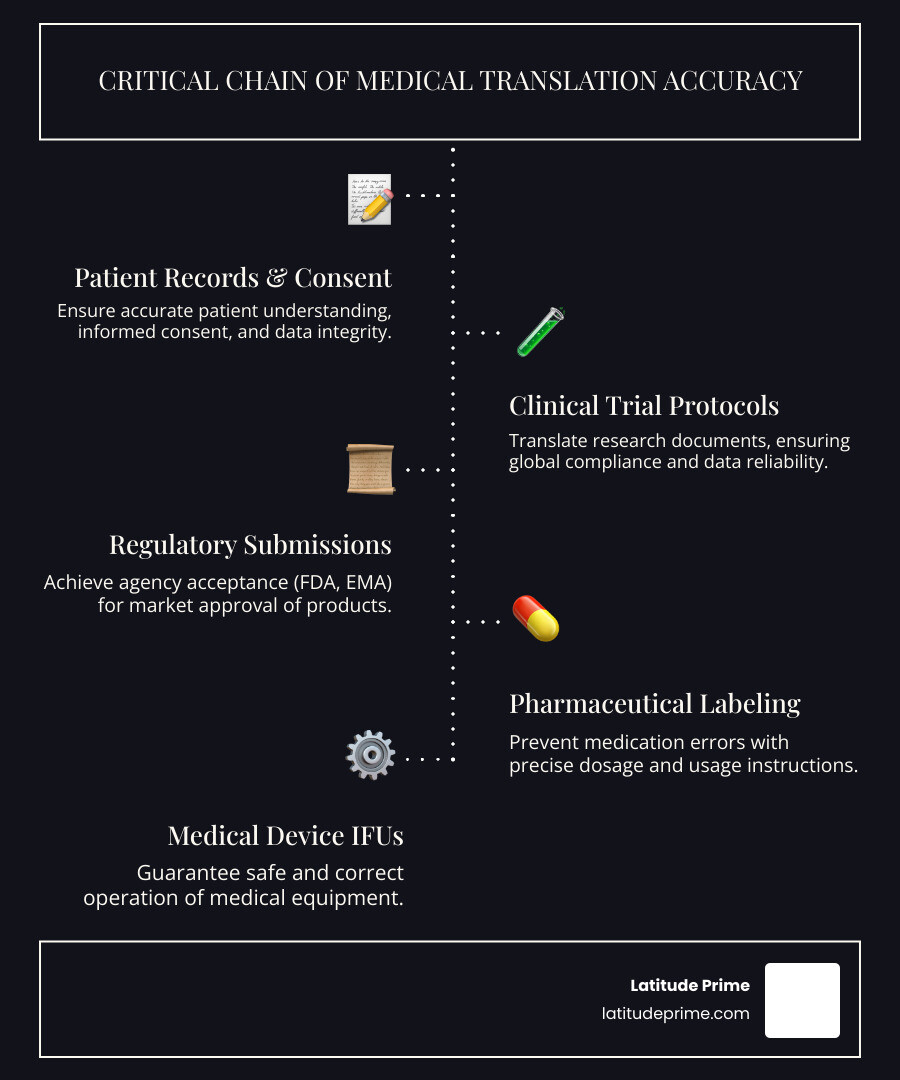
Medical translations are not just beneficial—they’re essential. As one hospital testimonial noted, using professional medical interpreters “increases patient understanding and compliance,” allowing healthcare teams to deliver high-quality care. The stakes are equally high for written materials: mistranslated dosage instructions can lead to incorrect medication administration, and incomplete consent forms can jeopardize clinical trials.
The consequences of poor translation extend beyond individual patient harm. Healthcare providers face legal liability, regulatory rejection of submissions to agencies like the FDA or EMA, and loss of trust from patients and research participants. Translation errors in clinical trial documentation can invalidate years of research. For medical device manufacturers, unclear instructions for use (IFUs) can result in equipment misuse and patient injury.
I’m William Kennedy, a Translation Project Manager with over a decade of experience coordinating medical translation services across 8,500+ language projects, including pharmaceutical documentation, clinical trial materials, and medical device localization. My background in managing complex multilingual workflows ensures every project meets the highest standards for accuracy and regulatory compliance.
What to Look for in High-Quality, Affordable Medical Translation Services
Finding the right medical translation services shouldn’t feel like choosing between quality and budget. The truth is, in healthcare, you can’t afford to compromise on accuracy—but that doesn’t mean you need to break the bank. Think of it this way: a good translation partner helps you invest wisely, not cheaply.
The key is knowing what actually matters. Not every service provider is created equal, and some of those price differences reflect genuine value while others are just marketing fluff. This section walks you through the essential qualifications and processes that separate professional medical translation from potentially dangerous guesswork.

Key Qualifications for Professional Medical Translation Services
Here’s something most people don’t realize: being fluent in two languages doesn’t make someone qualified to translate your medical documents. Would you trust someone who speaks English and Spanish to perform surgery just because they can explain what a scalpel is? Of course not.
The same principle applies to medical translation. Your translator needs to understand the medicine itself, not just the words describing it.
Subject matter expertise is non-negotiable. At Latitude Prime, many of our linguists are practicing or former doctors, nurses, pharmacists, or hold advanced degrees in life sciences. When they translate a clinical trial protocol, they’re not just converting words—they’re understanding the methodology, recognizing potential safety concerns, and ensuring nothing gets lost in translation. This medical background helps them spot errors that a general translator would miss entirely.
Native-speaking translators bring another critical layer of accuracy. Medical terminology is complex enough in one language, but cultural nuances can completely change how patients understand health information. A native speaker knows which phrases resonate with patients and which might cause confusion or even offense. This becomes especially important in patient-facing materials like consent forms or discharge instructions.
Certifications and accreditations provide verification that your translator knows their stuff. Look for recognized credentials in both translation and their medical specialty. Our network includes linguists who’ve dedicated over a decade specifically to medical translation services, continuously updating their knowledge as medical science advances. Medicine doesn’t stand still, and neither should your translators.
Specialization within medicine matters more than you might think. The medical field isn’t monolithic—pharmaceuticals require different expertise than medical devices, which differ from clinical research documentation. A translator who excels at drug labeling might struggle with biotechnology patents. We carefully match each project to linguists whose specialization aligns with your specific content, whether that’s regulatory affairs, dental technology, or medical imaging.
Differentiating Translation from Interpretation
Let’s clear up a common confusion: translation and interpretation aren’t interchangeable terms, even though people often use them that way. They’re related but distinct services, and knowing which one you need saves time and money.
Translation handles written documents—everything from patient records and drug labels to clinical trial protocols and research papers. Interpretation handles spoken communication in real-time, like doctor-patient consultations or telehealth appointments. Different skills, different training, different situations.
Think about when you need written versus spoken language support. If you’re submitting regulatory documents to the FDA, you need translation. If a Spanish-speaking patient is sitting in your exam room right now, you need interpretation.
For written medical materials, translation covers patient information leaflets, discharge instructions, regulatory submissions, informed consent forms, diagnostic reports, pharmaceutical labels, medical device instructions, scientific publications, and health insurance documents. Basically, if it’s on paper (or PDF), that’s translation territory.
For spoken communication, interpretation becomes essential during patient consultations, when obtaining informed consent, in emergency situations, for telehealth appointments, during psychiatric evaluations, in group therapy sessions, and at medical conferences. When people need to talk to each other across language barriers, that’s interpretation.
We offer comprehensive support for both needs. Our Video Medical Interpreter services connect healthcare providers with qualified interpreters instantly, while our Interpreter Health and Social Care programs support broader community health initiatives.
Evaluating a Provider’s Quality Assurance Process
Here’s where you separate the professionals from the pretenders. Anyone can claim they provide quality translations, but a robust quality assurance process proves it. At Latitude Prime, accuracy isn’t just a goal—it’s guaranteed through multiple checkpoints.
Multi-step review forms the foundation of reliable medical translation. Our standard workflow includes initial translation by a qualified linguist, thorough editing by a second independent expert, and final proofreading to catch any remaining issues. For highly complex or sensitive projects, we might involve up to five separate specialist checks. Yes, this takes more time than having one person translate and call it done. That’s the point.
Dual-translator review means at least two qualified professionals examine every document. The primary translator handles the initial conversion, then an independent editor reviews their work with fresh eyes. This catches errors the first translator might miss and ensures consistency in terminology and style. It’s like having a second surgeon verify the procedure before closing—an extra safeguard when mistakes aren’t acceptable.
We back this process with an error-free guarantee. If you’re ever unsatisfied with a translation, we provide a free comprehensive review and correction. Some of our specialized partners even offer a full-year accuracy warranty on each project. That’s not just confidence—it’s accountability.
Client feedback drives continuous improvement. We actively seek your input after every project, integrating your observations into our processes. This creates a feedback loop that benefits all our clients as we refine our methods and adapt to evolving industry standards.
For spoken language support, our Video Remote Interpreting Healthcare services undergo similarly rigorous quality standards, ensuring clarity and precision even in complex medical discussions.
How Document Type and Technology Impact Your Budget
Let’s talk about money. We know that budget matters, especially when you’re managing healthcare costs across multiple languages. The good news? Understanding how different documents and smart technology use affect pricing can help you plan more effectively—and even save significantly—without compromising on the quality your patients deserve.

Common Medical Documents and Their Translation Complexity
Here’s something that surprises many of our clients: not all medical translation services cost the same. A patient discharge summary and a clinical trial protocol might both be “medical documents,” but they require vastly different levels of expertise, review time, and specialized knowledge.
Think of it this way: translating a patient information leaflet is like explaining a medical procedure to your neighbor—it needs to be clear, accessible, and culturally sensitive, but the terminology is relatively straightforward. On the other hand, translating a regulatory submission to the FDA is like writing a legal brief in highly technical medical language—every word carries weight, and the consequences of errors are severe.
| Document Type | Complexity Level | Required Expertise | Relative Cost |
|---|---|---|---|
| Patient Records | Medium | Medical terminology, patient confidentiality | Medium |
| Patient Information Leaflets | Low-Medium | Clear, concise language, cultural sensitivity | Low-Medium |
| Marketing Brochures | Medium | Marketing localization, medical knowledge | Medium |
| Hospital SOPs | Medium | Institutional procedures, medical terminology | Medium |
| Informed Consent Forms | Medium-High | Legal, ethical, medical terminology | Medium-High |
| Medical Reports/Diagnostics | High | Specialized medical jargon, diagnostic procedures | High |
| Clinical Trial Protocols | High | Regulatory, scientific, specific methodology | High |
| Regulatory Documents | High | Legal, compliance, specific agency guidelines (FDA, EMA) | High |
| Medical Device IFUs/Manuals | High | Technical, engineering, safety regulations | High |
| Scientific Publications/Patents | Very High | Niche scientific fields, dense academic language | Very High |
We handle the full spectrum at Latitude Prime. Whether you need clinical study reports and case report forms, drug labels and package inserts, medical software localization, or biomedical and biopharma documentation, we match your project with linguists who specialize in that exact field. We’ve also translated everything from medical eLearning programs to public health vaccination guides and emergency response documentation.
The complexity level directly impacts cost because it determines how much specialized expertise and review time each document requires. A medical device instruction manual might need an engineer-turned-translator who understands both the technical specifications and safety regulations. A scientific patent could require a PhD-level specialist in that specific medical subfield. This expertise doesn’t come cheap, but it’s absolutely essential for accuracy.
How Technology Reduces Costs for Medical Translation Services
Now for the exciting part: how we use technology to make medical translation services more affordable without sacrificing an ounce of quality.
Imagine you’re translating a series of clinical trial documents. Certain phrases appear over and over: “adverse event,” “informed consent,” “inclusion criteria.” Without technology, a translator would manually translate these identical phrases hundreds of times across dozens of documents. That’s time-consuming and expensive—plus it introduces the risk of inconsistency.
Enter Translation Memory (TM). This powerful tool stores every sentence or phrase we’ve previously translated in a secure database. When that same phrase appears again, the system instantly retrieves the approved translation. The result? We can offer you reduced rates on repeated content—sometimes saving you 30-50% on large projects with significant repetition. You’re essentially paying only for new translation work, not for re-translating content we’ve already perfected for you.
Terminology Management Systems work hand-in-hand with Translation Memory. These specialized databases ensure that critical medical terms—like specific drug names, medical device components, or disease classifications—are translated exactly the same way every single time, regardless of which translator is working on your project. This consistency isn’t just about saving money; it’s about patient safety and regulatory compliance.
CAT (Computer-Assisted Translation) tools bring everything together in one streamlined environment. Think of them as mission control for our translators, integrating Translation Memory, terminology databases, and quality checks all in one place. They help our linguists work faster and smarter, and those efficiency gains translate directly into cost savings for you.
We’re also thoughtfully integrating AI-powered systems into our workflow. Before you worry—no, we’re not letting robots translate your clinical trial protocols unsupervised. Instead, we use machine learning to handle repetitive tasks, suggest translations for our expert linguists to review, and help our project managers optimize workflows. It’s human expertise amplified by artificial intelligence, not replaced by it.
The beauty of this technological approach is that it benefits everyone. You get faster turnaround times and lower costs on projects with repeated content. We can handle larger volumes more efficiently. And most importantly, consistency and accuracy improve across all your documents—which is exactly what patients and regulators need.
If you’re managing interpretation needs alongside translation, our team can guide you on the best technological solutions for those services as well.
Ensuring Regulatory Compliance and Confidentiality
When it comes to medical translation services, protecting patient information and meeting regulatory standards isn’t optional—it’s the foundation of everything we do. We know you’re trusting us with some of the most sensitive data imaginable, and we take that responsibility seriously.

Navigating HIPAA and Data Security
Patient data deserves the highest level of protection. In the United States, this is governed by the Health Insurance Portability and Accountability Act (HIPAA), while international work often falls under GDPR. You need a translation partner who understands this legal landscape and has systems in place to safeguard every document.
At Latitude Prime, HIPAA compliance is built into our DNA. Every team member—from project managers to linguists—operates under a strict Code of Ethics and signs comprehensive Non-Disclosure Agreements (NDAs) before touching any client materials. This legally binds them to protect your information, and we enforce these policies rigorously.
But paperwork alone isn’t enough. We back up our confidentiality promises with robust technical safeguards. All documents are transferred using secure file transfer protocols with encryption, so your sensitive materials never travel unprotected across the internet. Once your files reach our systems, they’re protected by data encryption at rest, managed firewalls, active logging, and network intrusion prevention measures.
Some of our trusted partners hold ISO/IEC 27001 certification, the international gold standard for information security management. This means their entire approach to handling data has been independently audited and verified by third-party experts.
The bottom line? Your patient information stays confidential from the moment you send it to us until the completed translation is securely returned. We understand that a single breach could harm patients, damage reputations, and expose you to legal liability—so we’ve built multiple layers of protection to ensure it never happens.
The Importance of ISO Certifications
You’ve probably seen companies tout their ISO certifications, but what do these actually mean for your medical translation services? Simply put, they’re proof that a provider has been independently audited and meets internationally recognized standards for quality and reliability.
ISO 9001:2015 covers quality management systems and demonstrates that a company has structured processes for consistently delivering high-quality services. It’s not just about having procedures—it’s about continuous improvement and putting customer satisfaction at the center of everything. When you work with an ISO 9001-certified provider, you know they’re committed to getting better with every project.
ISO 17100:2015 is specifically designed for translation services. This certification covers everything from translator qualifications and technical resources to quality assurance processes and client relationships. It ensures that the entire translation workflow—not just the linguists themselves—meets rigorous professional standards. For you, this means predictable quality, clear communication, and translations that consistently meet your expectations.
For medical device manufacturers, ISO 13485:2016 is particularly important. This certification focuses specifically on quality management for medical devices and related services. If you’re preparing instructions for use (IFUs), user manuals, or regulatory documentation for medical devices, working with an ISO 13485-certified provider ensures your translations meet the same quality standards as your product development process.
Why does all this matter? Because regulatory authorities like the FDA and EMA often require certified translations for product submissions. When your documentation comes from an ISO-certified provider, regulatory reviewers know it’s been produced according to internationally recognized standards. This can mean the difference between smooth approval and costly delays.
At Latitude Prime, our ISO certifications aren’t just badges on our website—they’re commitments to excellence that are verified through regular independent audits. You can Learn more about industry standards and how our certifications ensure your translations will meet regulatory requirements anywhere in the world.
Frequently Asked Questions about Medical Translation
We’ve been working with healthcare providers, pharmaceutical companies, and medical device manufacturers for years, and we’ve noticed the same concerns come up again and again. Here are the questions we hear most often about medical translation services, along with honest answers based on our experience.
What are the consequences of a bad medical translation?
Let’s be blunt: a single word translated incorrectly in a medical document can change someone’s life—or end it. This isn’t an exaggeration, and it’s exactly why we take our work so seriously.
When dosage instructions are mistranslated, patients take the wrong amount of medication. When medical histories are inaccurate, doctors make decisions based on false information. When treatment plans aren’t clear, healthcare providers might perform the wrong procedures. These aren’t hypothetical scenarios—they happen, and the results can be devastating.
Incorrect diagnoses stem from poorly translated patient symptoms or test results. A healthcare provider who can’t understand what’s actually wrong with a patient will naturally struggle to help them. Meanwhile, the patient continues to suffer, their condition potentially worsening while they wait for appropriate care.
The legal and financial consequences are equally serious. Healthcare facilities face malpractice lawsuits when translation errors lead to patient harm. Pharmaceutical companies deal with product recalls and regulatory fines. Clinical trials get invalidated because consent forms or protocols contained errors, wasting years of research and millions of dollars.
For medical device manufacturers, unclear instructions for use can result in equipment misuse, patient injury, and regulatory rejection from agencies like the FDA or EMA. The cost of fixing these problems—re-translating documents, managing legal battles, rebuilding trust—far exceeds what it would have cost to invest in quality medical translation services from the start.
We’ve seen the aftermath of bad translations, which is precisely why we maintain such rigorous quality standards. Your patients, your research participants, and your business deserve nothing less.
How are medical translation costs calculated?
We believe in transparent pricing, so let’s walk through exactly how we calculate costs for medical translation services.
Most of our projects use a per-word rate based on your source document. But here’s where it gets interesting—and where you can actually save money. Our translation memory technology identifies words and phrases we’ve already translated for you in previous projects. You don’t pay full price for content that’s been translated before. We offer reduced rates for repetitions and “fuzzy matches” (segments that are very similar to previously translated content).
The language pair you need affects pricing too. Spanish or French translations typically cost less than, say, Finnish or Vietnamese, simply because there are more qualified medical translators available for common languages. It’s basic supply and demand.
Subject matter expertise plays a significant role. A patient information leaflet requires medical knowledge, certainly, but a complex oncology research paper demands a translator with advanced specialization in that exact field. The more specialized the content, the higher the rate—but you’re paying for expertise that ensures accuracy.
Your turnaround time matters as well. Give us reasonable time to complete your project, and you’ll get our standard rates. Need it tomorrow? We can make that happen, but rush projects require rush fees because we’re asking our linguists to prioritize your work over other commitments.
We provide detailed quotes for every project, breaking down exactly what you’re paying for. No surprises, no hidden fees—just honest pricing that reflects the expertise and technology we bring to your medical translation services.
Are my documents kept confidential?
Yes. Absolutely, unequivocally, yes.
We understand that you’re trusting us with some of the most sensitive information imaginable—patient health records, proprietary pharmaceutical research, clinical trial data, intellectual property. That trust is sacred to us, and we protect it with multiple layers of security.
Every person who touches your project—translators, editors, proofreaders, project managers—signs non-disclosure agreements before they start working with us. They’re legally bound to keep your information confidential, and we take violations seriously.
Your documents travel through secure, encrypted platforms from the moment you send them to us until we deliver the final translations back. Our infrastructure includes advanced network security, managed firewalls, and active monitoring to prevent unauthorized access. Some of our partners maintain ISO 27001 certification, the international standard for information security management, providing an additional layer of verified protection.
For healthcare providers in the United States, HIPAA compliance isn’t optional—it’s the law. Our processes are specifically designed to meet and exceed HIPAA requirements for protecting patient health information. We understand the regulations, and we’ve built our entire workflow around maintaining compliance.
Beyond legal requirements and technical security, there’s something more fundamental at play: professional ethics. Our team operates under a strict code of conduct that prioritizes your confidentiality. We don’t just protect your information because we have to—we do it because it’s the right thing to do.
When you work with us for medical translation services, you can trust that your documents, your patients’ privacy, and your competitive information remain secure. That’s not just a promise—it’s how we’ve operated for over a decade.
Conclusion: Finding the Right Partner for Your Needs
Choosing the right medical translation services partner isn’t about finding the lowest price—it’s about finding a team you can trust with your patients’ lives and your organization’s future. We’ve covered what truly matters: certified linguists with medical expertise, ironclad quality assurance, cost-saving technology, and robust security measures.
Here’s what it comes down to: a single mistranslated word can change a patient’s outcome. That’s not hyperbole. It’s the reality we face every day in healthcare. So while budget considerations are real and valid, the cost of getting it wrong—in patient harm, legal liability, or failed regulatory submissions—far outweighs any savings from choosing an unqualified provider.
The landscape of medical translation is evolving rapidly. Healthcare is becoming more global by the day, with clinical trials spanning continents and patients seeking care across borders. Medical science advances at a breathtaking pace, creating new terminology that didn’t exist five years ago. Regulatory requirements grow more stringent and complex. The need for precise, culturally sensitive, and technologically advanced language solutions has never been greater.
At Latitude Prime, we’ve built our reputation on understanding these challenges from the inside out. Our ISO-certified quality management system isn’t just a badge on our website—it’s a daily commitment to excellence that shows up in every translated document. Our network of expert linguists spans over 300 languages, and many of them are doctors, nurses, and pharmacists themselves. They don’t just translate words; they understand the medicine behind them.
We serve clients across Minneapolis, Washington DC, San Diego, Miami, Fort Lauderdale, and around the world, but our approach remains personal and attentive. Whether you’re a small clinic needing patient discharge instructions or a pharmaceutical company preparing for FDA submission, you’ll work with a dedicated project manager who knows your needs and your timeline. We protect your data with the same rigor we apply to our translations—because we know that trust is earned through both accuracy and confidentiality.
The future of healthcare depends on clear communication across languages and cultures. When you partner with the right medical translation services provider, you’re not just checking a compliance box. You’re ensuring that every patient understands their treatment, every clinical trial maintains its integrity, and every medical device reaches the people who need it with clear, accurate instructions.
Ready to work with a partner who treats your medical content with the precision and care it deserves? Find your certified medical translation solution with Latitude Prime today. Let’s bridge the language gaps that stand between healthcare providers and the patients they serve.
