

Speak Their Language: Designing Impactful Multilingual eLearning Experiences
Why Multilingual eLearning Matters in Today’s Global Workplace
Multilingual eLearning is the practice of creating and delivering training content in multiple languages to ensure learners can access educational materials in their native or preferred language. This approach goes beyond simple translation—it involves adapting content culturally, technically, and pedagogically to create effective learning experiences for diverse global audiences.
Key components of multilingual eLearning include:
- Content localization – Adapting course materials, assessments, and navigation for specific languages and cultures
- Platform support – Learning Management Systems (LMS) that offer multilingual interfaces and reporting
- Cultural adaptation – Modifying examples, visuals, and references to resonate with local contexts
- Technical integration – Supporting diverse character sets, right-to-left languages, and regional formats
The need for multilingual eLearning has never been more urgent. 40% of school-aged children globally do not have access to education in a language they understand—a barrier that extends into corporate training and professional development. When learning materials are delivered only in languages that employees or students aren’t proficient in, comprehension suffers, engagement drops, and training investments fail to deliver returns.
Organizations expanding internationally face a critical choice: invest in proper multilingual eLearning or accept fragmented learner experiences, compliance risks, and lower training effectiveness. Without a unified multilingual platform, companies struggle with administrative overload, inability to measure global impact, and significant barriers to scale.
The benefits of getting this right are substantial. Multilingual eLearning improves global reach, improves learning outcomes through cultural relevance, increases engagement by meeting learners where they are, and ensures compliance with regional regulations that mandate training in specific languages.
I’m William Kennedy, and I’ve managed over 8,500 language projects in the past four years, including extensive work with multilingual eLearning content across technical, compliance, and training materials. My experience has shown me that successful multilingual eLearning requires more than translation—it demands a strategic approach that balances linguistic accuracy, cultural sensitivity, and technical execution.
Why Multilingual Learning is a Strategic Imperative
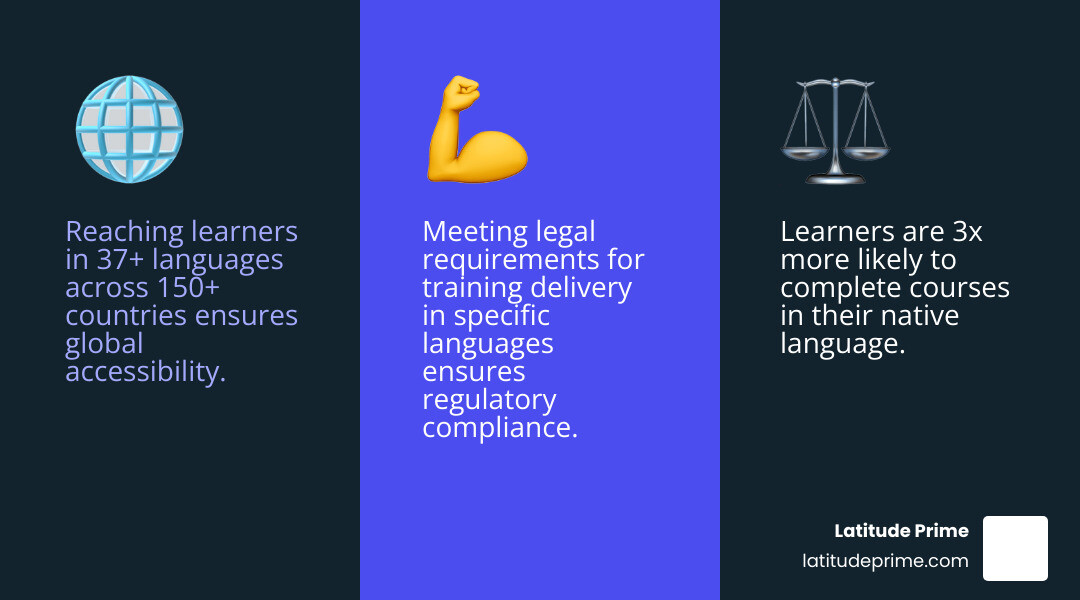
In our increasingly interconnected world, where businesses and educational institutions operate globally, the demand for multilingual eLearning content has grown exponentially. It’s no longer just a nice-to-have; it’s a strategic imperative that significantly impacts global reach, learning effectiveness, and even legal compliance.
Multilingual eLearning is about breaking down language barriers and making learning accessible to everyone, regardless of their native tongue. This means presenting educational materials in the learner’s own language, which profoundly impacts comprehension and skill development. When learners can engage with content in a language they understand deeply, they absorb information more effectively, leading to improved learning outcomes. Imagine trying to grasp complex technical concepts while simultaneously struggling with unfamiliar vocabulary – it’s a recipe for frustration and disengagement.
The benefits extend far beyond individual comprehension:
- Improved Global Reach: For businesses expanding into new international markets, multilingual eLearning is crucial for training employees, partners, and customers worldwide. Educational institutions can attract and cater to a diverse student population globally by offering courses in multiple languages. Platforms like Docebo and Cornerstone Learning support over 50 languages, while Litmos handles more than 37, and Moodle boasts support for over 100 languages through language packs. This widespread language support allows organizations to truly operate on a global scale.
- Improved Learning Experience: Presenting material in a learner’s native language fosters a sense of belonging and makes the learning journey more intuitive, relevant, and engaging.
- Increased Engagement: Learners are more likely to participate, ask questions, and apply what they’ve learned when training is in their own language. This proactive approach fosters motivation and deeper understanding, which is key to retention.
- Better Comprehension: This is perhaps the most obvious, yet most critical, benefit. When learning materials are delivered in a language a learner fully understands, comprehension suffers. This is particularly vital for complex subjects or safety training, where misinterpretation can have serious consequences.
- Catering to Diverse Learning Styles: Culturally adapted multilingual eLearning can cater to diverse learning styles influenced by cultural backgrounds, making content more relatable and effective.
- Compliance with Regional Regulations: In many parts of the world, legal requirements or regulations mandate that educational materials, especially for compliance or safety training, be provided in specific local languages. For organizations operating across the United States and globally, ensuring compliance is paramount to avoid penalties and foster trust.
The challenge is significant. According to UNESCO, 40% of school-aged children globally do not have access to education in a language they understand. This barrier persists in the workforce, highlighting the urgent need for accessible learning solutions that speak to everyone.
A Step-by-Step Guide to Creating Effective Multilingual eLearning
Creating effective multilingual eLearning is a journey that requires careful planning, cultural sensitivity, and technological savvy. It’s not a one-size-fits-all solution, but a custom approach designed to resonate with diverse audiences.
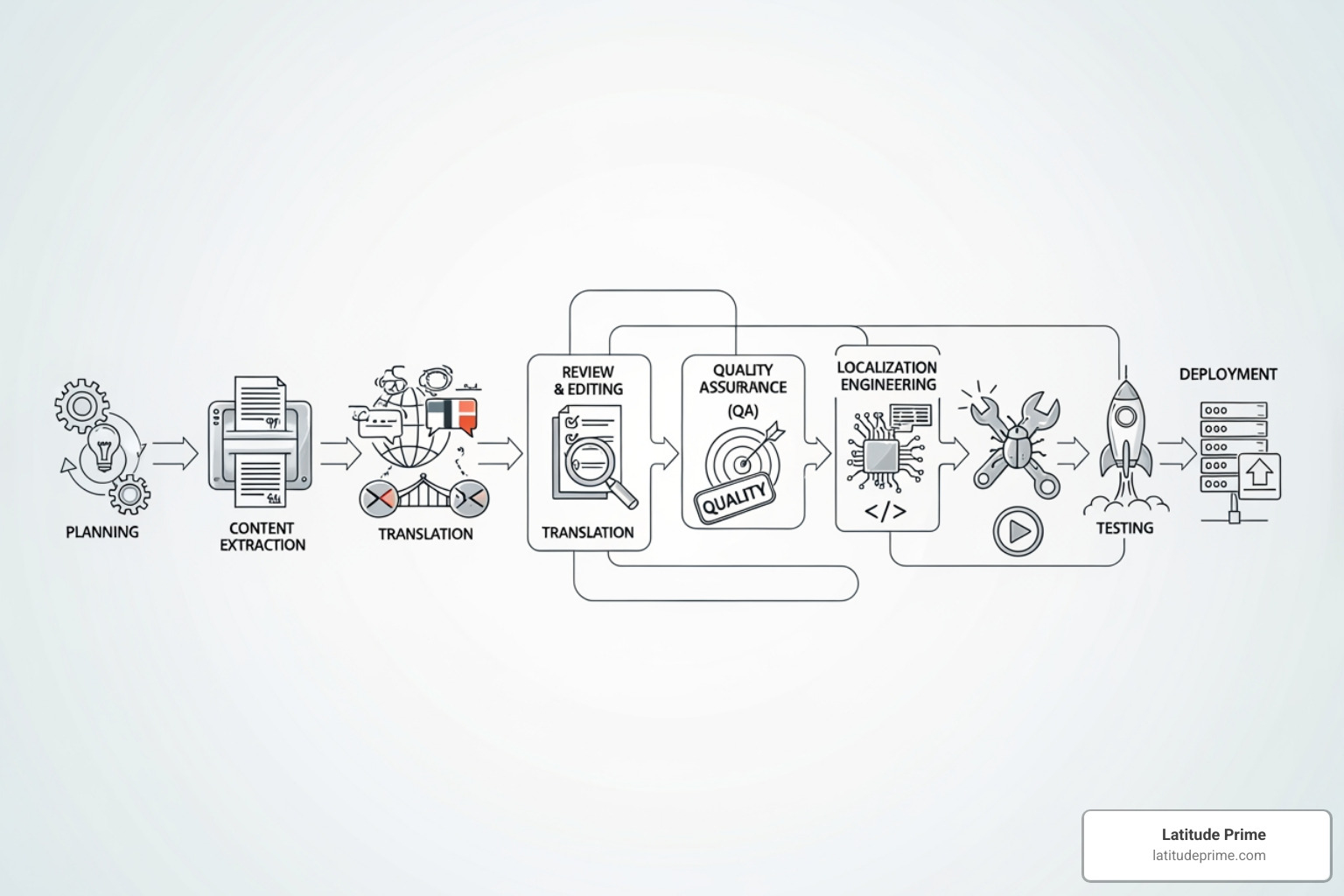
Our process begins with meticulous initial planning. This involves more than just identifying the languages you need. It starts with thorough market research to understand your target audiences, their specific language preferences, and their cultural contexts. What are their learning needs? What are their technological capabilities? By defining clear objectives for your multilingual eLearning initiative, you can ensure that every step of the development process aligns with your goals. For more detailed insights into this foundational stage, explore our resources on best practices for eLearning localization.
From Translation to Transcreation: Ensuring Cultural Relevance
One of the biggest misconceptions in multilingual eLearning is that translation alone is sufficient. In reality, successful global learning requires transcreation—a process that goes far beyond word-for-word translation to adapt content culturally.
Literal translations can often lead to misinterpretations, confusion, or a complete loss of context. What might be perfectly appropriate in one culture could be insensitive or even offensive in another. We’ve seen examples where even a simple “thumbs-up” emoji, commonly understood as positive in the United States, can have entirely different, sometimes negative, connotations in other regions. This is where cultural adaptation plays a critical role in the success of multilingual eLearning.
Transcreation involves:
- Adapting Visuals and Imagery: We review and adapt images, colors, and symbols to ensure they are culturally appropriate and resonate positively with the target audience.
- Avoiding Idioms and Colloquialisms: Our experts rephrase content to convey the intended meaning naturally, avoiding idioms that don’t translate directly.
- Localizing Examples and Case Studies: We adapt examples, units of measurement, currencies, and cultural references to the local context to make learning relevant.
This deep dive into cultural nuances is why we emphasize the distinction between translation service vs. localization service. While translation focuses on linguistic accuracy, localization, and especially transcreation, ensures that the content feels as though it was originally created for that specific audience. This approach is central to our transcreation services, ensuring your message is not just understood, but truly felt.
Best Practices for Content Design and Quality Assurance
To ensure your multilingual eLearning is truly impactful, we adhere to a set of rigorous best practices in content design and quality assurance:
- Clear, Concise Language and Avoiding Jargon: Even before translation, source content should be written in clear, unambiguous language, free of unnecessary jargon, idioms, and colloquialisms. This simplifies the translation process and reduces the risk of misinterpretation.
- Responsive Design for All Devices: Learners access content on a variety of devices, from desktops to mobile phones. Implementing responsive design ensures that your multilingual eLearning content adapts seamlessly to different screen sizes and operating systems, providing an optimal user experience regardless of the device. This is especially important for global audiences where mobile-first access is common.
- Handling Right-to-Left Languages and Diverse Character Sets: Technical integration must account for languages like Arabic or Hebrew, which are read from right-to-left. This affects layout, text alignment, and user interface elements. Similarly, supporting diverse character sets is crucial to display all languages accurately.
- Using Professional Translators with Subject Matter Expertise: We use professional translators with deep technical skills and subject matter expertise, backed by our ISO-certified quality management system, to ensure accuracy and correct terminology for specialized content.
- Subject Matter Expert Review: Translated content is rigorously reviewed by native-speaking subject matter experts in the target region to validate linguistic accuracy and cultural relevance.
- Pilot Testing with Target Audiences: Before full deployment, we conduct pilot tests with learners from each target market to gather feedback and refine the content for maximum effectiveness.
By following these best practices, we aim for impeccable quality and accuracy, ensuring that your multilingual eLearning content delivers a consistent, high-impact experience to every learner.
Overcoming Common Challenges in Multilingual eLearning
While the benefits of multilingual eLearning are clear, the path to implementation can present several challenges. However, with careful planning and the right partners, these obstacles are entirely surmountable.
- Managing Content Updates: Keeping content updated across many languages is a major challenge. Our solution involves planning for localization from the start, structuring content for easy updates, and using robust content management systems to streamline the process.
- Ensuring Consistency Across Languages: Maintaining a consistent brand voice, terminology, and instructional intent across all language versions is crucial. Inconsistencies can lead to confusion and erode trust. We achieve this through comprehensive terminology management, glossaries, and style guides that are carefully followed by our expert linguists.
- Technical Integration with Learning Management Systems (LMS): Integrating multilingual content can be complex, with issues like right-to-left languages and diverse character sets. Choosing a capable LMS and working with an experienced team is key to a seamless experience.
- Budget and Timeline Management: Multilingual projects require significant investment. Effective project management and clear communication are essential to stay on schedule and within budget. Outsourcing eLearning localization to expert providers can also lead to cost savings of up to 40%.
By anticipating these challenges and implementing proactive strategies, we help organizations steer the complexities of multilingual eLearning, changing potential problems into opportunities for growth and global engagement.
Leveraging Technology and AI for Scalable eLearning
The landscape of multilingual eLearning is constantly evolving, with technology and artificial intelligence playing an increasingly pivotal role. These tools are not just fancy add-ons; they are essential for streamlining workflows, ensuring consistency, and achieving the scalability required for global learning initiatives.

Technology, particularly language technology solutions, allows us to manage vast amounts of content across many languages with greater efficiency. It helps us automate repetitive tasks, maintain terminology consistency, and integrate seamlessly with various platforms. While technology provides powerful tools, we always emphasize that leveraging automatic translation should complement, not replace, human expertise. The synergy between AI tools and human linguists is where the real magic happens.
Essential Authoring Tools and LMS Features
The right authoring tools and Learning Management Systems (LMS) are the backbone of any successful multilingual eLearning program. When selecting your platform, look for key features that simplify the localization process:
- LMS Language Support: A robust LMS should offer a localized interface for learners, allowing them to steer the platform, receive notifications, and access help content in their preferred language. Many leading LMS platforms are designed with this in mind. For example, Moodle supports over 100 languages, while Docebo and Cornerstone Learning support 50+ languages. Others like Litmos, Talent LMS, Absorb LMS, and iSpring Learn offer support for 30+ languages, and LearnUpon and Blackboard Learn support 20+ languages. This platform-wide language support is crucial for a truly inclusive experience.
- XLIFF Export/Import Functionality: Many authoring tools, such as Rise 360 and Lectora, allow you to export course content as XLIFF (XML Localization Interchange File Format) files. This standardized format is a game-changer for translation workflows, making it easy to send content to translation services and then import the translated files back into your course, preserving formatting and structure. Adobe Captivate also offers export options to .doc or .xml for translation.
- Features to Support Multilingual Course Creation and Management: Look for platforms that allow for easy management of different language versions of a course within a single project. This includes functionalities like managing multiple audio tracks, text layers, and visual elements for each language.
- Captioning and Subtitle Support for Accessibility: For video-based content, the ability to add captions and subtitles in multiple languages is essential for accessibility and comprehension. Tools like Camtasia allow you to export existing captions and create additional caption files (SRT or VTT formats) in different languages. This also extends to multilingual voiceovers for an even more immersive experience.
Beyond these, features like localized eCommerce capabilities (for selling courses globally with appropriate currency and taxation), geography-based automation (for assigning training based on location), and custom branding for different regional tenants are invaluable for global deployment.
The Role of AI in Translation and Content Creation
Artificial Intelligence is revolutionizing multilingual eLearning, making content creation faster, more efficient, and more scalable than ever before.
- AI-Powered Translation: AI tools can provide instant first drafts of translations, significantly speeding up the localization process. Some platforms even offer AI-powered course creation in 50+ languages.
- Machine Translation Post-Editing (MTPE): Since AI translation requires human refinement for nuance and accuracy, MTPE is a crucial step. This “human-in-the-loop” process involves expert linguists reviewing and editing AI-generated text to ensure quality and cultural appropriateness.
- AI for Generating First Drafts: AI can generate initial drafts of course content, quizzes, and multimedia scripts, allowing instructional designers to focus on refining the learning experience.
- AI-Powered Voiceovers and Subtitles: AI can generate realistic voiceovers and accurate subtitles in multiple languages, dramatically reducing the time and cost of multimedia localization. Some AI tools can also translate communications in real-time and recommend language-adaptive visuals.
While AI is a powerful ally, it should always complement human expertise. For us, AI tools streamline the initial steps, but the final review and cultural adaptation always involve our expert linguists to guarantee the highest quality and impact.
Measuring Success and The Future of Global Learning
Once your multilingual eLearning initiatives are launched, the work isn’t over. Measuring their effectiveness is crucial to understand your return on investment, identify areas for improvement, and continuously refine your strategy.
How can organizations measure the effectiveness and impact of their multilingual eLearning initiatives? We look at several key performance indicators (KPIs):
- Learner Engagement Metrics: Track participation rates, time spent on courses, and interaction with interactive elements. Higher engagement in localized content indicates success in cultural relevance and accessibility.
- Course Completion Rates: Compare completion rates across different language versions. A significant drop in completion rates for a particular language might signal issues with comprehension or cultural adaptation.
- Assessment Scores Across Languages: Analyze performance on quizzes and assessments. Consistent scores across language groups suggest effective content delivery and accurate knowledge transfer. Discrepancies can highlight areas where translation or cultural adaptation needs refinement.
- Feedback and Surveys: Directly solicit feedback from learners in their native languages. This qualitative data provides invaluable insights into their experience, challenges, and suggestions for improvement.
- Compliance Adherence: For mandatory training, measure the rate of compliance in each region. This directly reflects the effectiveness of your multilingual eLearning in meeting regulatory requirements.
- Unified Reporting and Analytics: A robust LMS should offer unified reporting dashboards that allow you to compare these metrics across different language groups from a single point. This helps identify patterns, pinpoint areas for content refinement, and demonstrate the global impact of your training programs.
The future outlook for multilingual eLearning is incredibly dynamic and promising. We anticipate continued advancements that will make global learning even more accessible, personalized, and impactful:
- Hyper-Personalization: Leveraging AI, future multilingual eLearning will offer even more custom experiences, adapting not just language but also content difficulty, examples, and learning paths based on individual learner profiles and cultural preferences. Adaptive learning based on language is already a reality, where modules in languages a learner doesn’t understand can be hidden, and content in their native language is prioritized.
- Increased Accessibility Through Technology: Further innovations in AI-powered voice recognition, real-time translation, and advanced multimedia localization will make learning instantly accessible to anyone, anywhere, regardless of their linguistic background. Imagine real-time translation of live virtual classrooms or automatically generated, culturally relevant course content at the click of a button.
- Global Collaboration: Multilingual eLearning will increasingly facilitate global collaboration, allowing diverse teams to learn together and share knowledge across linguistic boundaries, fostering a truly interconnected learning environment.
As technology continues to shrink our world, multilingual eLearning will become an even more critical tool for fostering inclusion, driving innovation, and empowering individuals and organizations to thrive in a globalized society.
Frequently Asked Questions about Multilingual eLearning
How do I handle specialized or regulated training content in multiple languages?
This requires a meticulous approach focused on accuracy and compliance. Our strategy includes:
- Partnering with Expert Translation Services: Work with services specializing in your industry’s compliance standards. Our network of technical linguists understands both the language and the specific regulatory context.
- Validating with Subject Matter Experts (SMEs): All content must be reviewed by native-speaking SMEs in the target region to ensure it is technically accurate and compliant with local regulations.
- Using a Capable LMS: A multi-language LMS helps manage the complexity of specialized content across multiple versions.
- Maintaining Terminology Glossaries: Develop glossaries for each language to ensure consistency and accuracy in highly technical or regulated content.
What’s the difference between localization and simple translation in eLearning?
This is a fundamental distinction.
- Simple Translation converts text from one language to another, focusing on literal meaning. It often misses cultural nuances, which can lead to misinterpretations.
- Localization is a broader process that adapts the entire eLearning experience to a specific culture and region. It includes adapting visuals, examples, and technical elements (like currencies and date formats) to make the content feel as if it were created specifically for that audience. Localization is crucial for connecting with learners on a cultural level, leading to better engagement and comprehension.
How can I measure the ROI of my multilingual eLearning program?
Measuring ROI involves assessing the program’s true impact beyond simple completion rates. Key methods include:
- Unified Reporting: Use your LMS to track and compare key metrics (engagement, completion rates, assessment scores) across all language groups.
- Knowledge and Performance: Use assessments to measure knowledge gain and track how learners apply new skills in their roles.
- Compliance and Risk: For compliance training, measure completion rates and track reductions in incidents or audit failures to demonstrate risk mitigation.
- Efficiency and Cost Savings: Quantify savings from reduced travel, faster onboarding, and improved productivity. Outsourcing localization can also save up to 40% in costs.
- Qualitative Feedback: Collect testimonials from learners and managers to understand the program’s impact.
Combining these measures provides a comprehensive picture of your program’s strategic value.
Conclusion
In today’s globalized landscape, multilingual eLearning is a strategic imperative. It empowers organizations to reach wider audiences, foster deeper engagement, and ensure high-quality learning experiences across diverse cultures. The impact is profound, from breaking down language barriers to ensuring regulatory compliance.
Success requires moving beyond simple translation to accept cultural adaptation, following best practices in design, and leveraging technology and AI to scale effectively.
At Latitude Prime, we understand this nuanced approach. Our ISO-certified quality management system and extensive network of expert technical linguists ensure your message is not just translated, but truly localized to resonate with every learner.
By partnering with experts for your Elearning Localization needs, you can transform your training initiatives into powerful tools for global growth and foster an inclusive learning culture where everyone can communicate with confidence.
