

Medical translation polish to english: 5 Vital Steps
Why Accurate Medical Translation Polish to English Matters for Your Healthcare Journey
Medical translation Polish to English is a specialized service that converts healthcare documents from Polish into English while maintaining precise medical terminology, regulatory compliance, and patient safety standards. Whether you’re an expat seeking treatment abroad, submitting medical records for immigration, or managing international clinical trials, professional medical translation ensures your health information is accurately understood.
Quick Resources for Polish to English Medical Translation:
- Certified Translation Services: Required for USCIS, courts, and universities ($25-$40 per page)
- Turnaround Time: 24 hours for simple documents, 3-5 days for 1-3 pages
- Essential Qualifications: Native translators with medical degrees or science backgrounds
- Key Documents: Patient records, clinical trial protocols, informed consent forms, medical device manuals
- Quality Standards: ISO 17100 certification, HIPAA compliance, Certificate of Accuracy included
Why Standard Translation Tools Won’t Work:
Machine translation struggles with complex medical terminology rooted in Latin and chemical formulas. As one client finded when preparing for a minor operation, Google Translate “failed to correctly process complex medical terms,” leaving her anxious and confused. Professional human translators with medical expertise prevent dangerous misunderstandings that could affect your diagnosis, treatment, or legal standing.
The stakes are high. Poland’s growing healthcare sector and expanding medical tourism market mean more patients than ever need reliable translation services. Poor language use in medical contexts has led to multi-million-dollar legal cases and compromised patient outcomes. Whether you’re translating a birth certificate for immigration, clinical trial documentation for regulatory approval, or patient histories for continuity of care, accuracy isn’t optional—it’s essential.
I’m William Kennedy, and I’ve managed over 8,500 language projects in the past four years, including extensive work with medical translation Polish to English for healthcare organizations, legal firms, and individual patients navigating complex regulatory requirements. Through my experience at Latitude Prime, I’ve seen how the right translation partner transforms confusing medical jargon into clear, actionable information that protects patient safety and ensures compliance.
Easy medical translation polish to english word list:
The Unique Challenges of Polish to English Medical Translation
Translating medical documents from Polish to English is far more intricate than simply swapping words. It’s a highly specialized field demanding a unique blend of linguistic mastery and deep scientific understanding. At Latitude Prime, we understand that medical translation requires a lot of knowledge and skills that only a translator specializing in this field has.
One of the primary challenges lies in the specialized terminology. The field of medicine uses a very precise and specialized vocabulary, often rooted in Latin and Greek. When translating between Polish and English, our linguists encounter complex medical words and terms that are based on these Latin roots, as well as intricate chemical formulas. A direct, word-for-word translation often misses the nuance, or worse, changes the meaning entirely. For instance, a common Polish term might have several English equivalents, each with a slightly different medical context. Choosing the wrong one could have significant consequences.
Then there are the linguistic nuances and grammatical differences between Polish and English. Polish is a highly inflected language with a more flexible word order, while English relies heavily on prepositions and a stricter sentence structure. This means a translator must not only understand the individual terms but also restructure sentences to convey the exact medical meaning naturally and accurately in English. We also have to be wary of “false friends” – words that look or sound similar in both languages but have completely different meanings, which can be particularly dangerous in medical contexts.
Cultural context in healthcare also plays a significant role. How symptoms are described, how diagnoses are delivered, and even the overall approach to patient care can differ between cultures. Our contracted translators are fluent in Polish and English vocabulary, specialized industry terminology, common phrases, and the culture of both languages. This holistic understanding contributes to accurately translating the meaning of the source document, ensuring that patient communication styles and expectations are respected and correctly interpreted. Medical content requires subject matter knowledge beyond linguistic skills for accurate conveyance. Without this specialized understanding, a translator might produce a grammatically correct but medically inaccurate document, which could lead to severe misunderstandings.
Why a Specialist is Crucial for Your Health and Safety
Imagine receiving a medical diagnosis or treatment plan that’s been poorly translated. The thought alone is enough to send shivers down your spine. In the field of healthcare, accuracy isn’t just a preference; it’s a matter of life and death. This is precisely why it is crucial to use specialized translators for medical documents. There is simply no room for error in medical translations.
The implications of inaccuracy are profound. A mistranslated symptom could lead to a misdiagnosis risk, delaying proper treatment or leading to an entirely incorrect treatment. For instance, a Polish term for a specific type of allergy might be confused with another, causing a patient to receive the wrong medication with potentially fatal results. Poor language use can lead to poor patient outcomes and multi-million-dollar legal cases. These aren’t just theoretical risks; they are real-world dangers that underscore the critical need for professional medical translation.
Beyond patient safety, there are severe legal consequences. Medical documents are often legally binding records. Whether it’s an informed consent form for a clinical trial, patient records for a court case, or regulatory submissions for a new drug, any inaccuracy can expose healthcare providers, pharmaceutical companies, and even patients to significant legal liability.
Furthermore, data security and HIPAA compliance are non-negotiable. Medical information is highly sensitive. Any translation service we provide must adhere to strict confidentiality protocols and data protection regulations, especially HIPAA in the United States. Our linguists are often specifically trained in HIPAA compliance to ensure your private health information is handled with the utmost care and security throughout the translation process. We ensure maximum confidentiality for all your sensitive documents.
Key Qualifications for a Medical Translator
When it comes to medical translation Polish to English, we don’t just pick any translator. We believe you cannot just trust anyone to translate medical documents. The stakes are too high. Our medical translators are carefully vetted professionals who possess a unique combination of linguistic talent and deep scientific expertise.
Here’s what we look for in our specialized medical translators:
- Medical Degrees or Science Background: It’s not enough to be fluent in Polish and English. Our translators often hold degrees in medicine, pharmacy, biology, chemistry, or related scientific fields directly relevant to the documents they translate. This ensures they master the terms and concepts of their chosen medical field, understanding the underlying science, not just the words.
- Professional Certifications: Many of our linguists hold certifications from reputable professional organizations like the American Translators Association (ATA), which signifies a commitment to ethical practices and high-quality standards.
- Native Fluency: We strongly believe that the best translations are done into a translator’s native language. Our Polish-to-English medical translators are native English speakers, ensuring idiomatic, natural, and culturally appropriate target texts. Conversely, for English-to-Polish translations, we use native Polish speakers.
- Years of Experience: Expertise isn’t built overnight. Our professional Polish translators have extensive experience providing certified medical records translations for individuals, law firms, universities, and government agencies. This practical experience means they’ve encountered a vast array of medical documents and terminology.
- Industry Specialization: Within the broad field of medicine, there are countless sub-specialties. We ensure that the assigned translator has specific knowledge in areas like cardiology, oncology, pharmaceuticals, medical devices, or clinical research, matching their expertise to your document’s specific content.
The Dangers of Inaccurate Translation
The ripple effects of an inaccurate medical translation Polish to English can be catastrophic. We’ve seen how seemingly minor linguistic errors can escalate into major problems, underscoring why accuracy is paramount.
Consider the potential for poor patient outcomes. If a patient’s medical history, including allergies or existing conditions, is mistranslated, they could receive medication that triggers a severe allergic reaction or interacts dangerously with other drugs. A mistranslated dosage instruction could lead to under-dosing, rendering treatment ineffective, or over-dosing, causing toxicity. In a hospital setting, this could mean delayed recovery, permanent injury, or even death. This is why professional human translation is crucial for accurate medical document understanding.
For healthcare providers and institutions, legal liability is a significant concern. An inaccurate translation can be grounds for malpractice lawsuits, regulatory fines, and reputational damage. When we translate documents that will be used in legal contexts, such as court cases or insurance claims, the precision must be absolute to protect all parties involved.
In the pharmaceutical and clinical research sectors, inaccurate translations can compromise clinical trials. If informed consent forms are not perfectly clear, participants may not fully understand the risks and benefits, invalidating their consent. Errors in trial protocols, patient diaries, or adverse event reports can lead to flawed data, jeopardize regulatory approval for new drugs or devices, and result in significant financial losses.
Such failures can lead to a damaged brand reputation. For any medical or pharmaceutical company, trust is everything. A single incident stemming from a translation error can erode years of trust with patients, healthcare professionals, and regulatory bodies. Our commitment to ISO-certified quality management systems and an extensive network of expert linguists helps mitigate these risks, delivering peace of mind alongside precise translations.
Your Guide to Professional Medical Translation Polish to English
Navigating medical translation Polish to English can seem daunting, but with the right partner, it becomes a streamlined and stress-free process. At Latitude Prime, we’ve refined our approach to ensure every translation meets the highest standards of accuracy and quality.

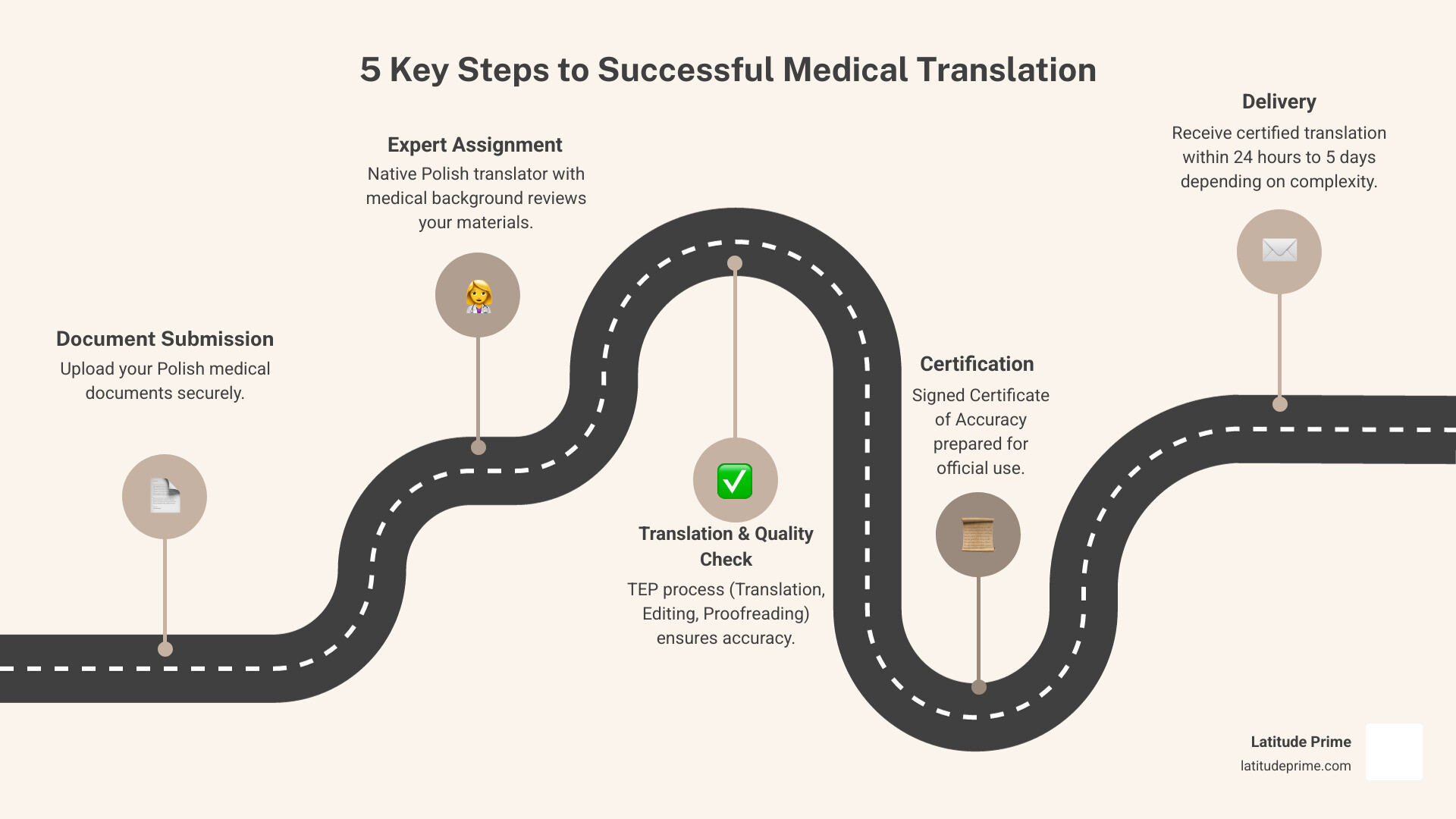
Our typical process for obtaining a Polish to English medical translation follows a meticulous multi-step workflow:
- Document Submission: You begin by submitting your Polish medical documents to us. This can be done securely through our online portal. We accept various formats, including PDFs, Word documents, and even high-resolution images.
- Project Assessment: Our project managers review your documents to understand their complexity, volume, and specific medical field. We identify any unique terminology or formatting requirements.
- Expert Translator Assignment: We assign your project to a specialist Polish-to-English medical translator. This isn’t just any translator; it’s a native English speaker with a strong medical or scientific background and specific expertise in the relevant medical field.
- Translation, Editing, Proofreading (TEP): This is the core of our quality assurance. The assigned translator completes the initial translation. Then, a separate, equally qualified medical linguist edits the translation for accuracy, completeness, and adherence to terminology. Finally, a third linguist proofreads the document to catch any lingering grammatical errors, typos, or formatting issues. This “fresh pair of eyes” principle guarantees a thoroughly reviewed and polished final product.
- Quality Assurance (QA): Beyond TEP, our advanced QA processes leverage sophisticated CAT (Computer-Assisted Translation) tools to ensure terminology consistency across the entire document and against any client-specific glossaries. This technology complements human expertise, guaranteeing uniform and precise language. Our ISO 9001 and ISO 17100 certifications mean that our quality management systems are independently verified to meet international standards.
- Certification (if required): For official use, we prepare a Certificate of Accuracy, attesting to the completeness and correctness of the translation.
- Delivery: Your accurately translated and quality-assured documents are delivered to you in your preferred format, often digitally within the agreed-upon timeframe.
Common Documents Requiring Translation
The need for medical translation Polish to English spans a wide array of documents, each critical for different aspects of healthcare, legal, and personal use. At Latitude Prime, we handle a comprehensive range of medical materials, ensuring precision across the board.
Here are some of the most common types of medical documents we translate:
- Patient Records and Medical Histories: Essential for continuity of care when patients move between countries or seek treatment abroad.
- Clinical Trial Documents: Including protocols, investigator brochures, informed consent forms (ICFs), patient diaries, and adverse event reports. These are vital for regulatory approval and patient safety in international research.
- Pharmaceutical Regulations and Documentation: Such as Summary of Product Characteristics (SmPCs), Patient Information Leaflets (PILs), drug labels, and drug registration documentation. Accuracy here is crucial for patient safety and market access.
- Medical Device Manuals and User Guides: Ensuring safe and effective use of medical equipment by healthcare professionals and patients.
- Scientific Research Papers, Journals, and Publications: Facilitating the global exchange of medical knowledge and advancements.
- Hospital Discharge Papers and Reports: Providing crucial information for follow-up care.
- Vaccination Records: Often required for international travel, school enrollment, or immigration.
- Medical Insurance Documents: For claims processing and understanding coverage abroad.
- Laboratory Test Results and Analysis: For diagnostic purposes and treatment planning.
- Questionnaires and Patient Surveys: Used in clinical research and healthcare quality assessments.
Certified vs. Standard Medical Translation Polish to English
Understanding the distinction between standard and certified medical translation is vital, especially when dealing with official bodies. The choice depends entirely on the purpose of your document.
A standard translation serves informational purposes. If you simply need to understand the content of a Polish medical journal article for your own research or internal review, a standard translation would suffice. While still requiring medical expertise, it doesn’t come with the formal attestation needed for official submissions.
A certified medical translation from Polish to English, however, is a formal declaration that the translation is a complete and accurate rendition of the original document. This type of translation is accompanied by a signed Certificate of Accuracy, which attests to the translator’s qualifications and the fidelity of the translation. Our professional Polish translators have extensive experience providing certified medical records translations for individuals, law firms, universities, and government agencies.
When do you need a certified translation? Most often, certified Polish to English translations are required for submission to the United States Citizenship and Immigration Services (USCIS). Many other institutions such as courts, universities, and state and federal agencies may also request a certified translation of documents originally in Polish.
For example, if you’re applying for a visa, green card, or citizenship, USCIS mandates certified translations of all foreign-language documents, including birth certificates, marriage certificates, and medical records. These translations must follow specific criteria established in Chapter 4 of the USCIS Documentation Manual and in the Electronic Code of Federal Regulations website. The translation will include all official signatures, stamps, logos, and coats of arms of the original document.
Additionally, for some official uses, particularly those involving international recognition, we can arrange for notarization or an e-Apostille. Notarization adds another layer of verification, where a Notary Public attests to the identity of the person signing the Certificate of Accuracy. An e-Apostille is required for documents to be recognized in countries that are part of the Hague Convention. We provide both regular and certified translation services of all medical documents.
Understanding Pricing and Turnaround Times
When seeking medical translation Polish to English services, two key considerations are pricing and turnaround times. We believe in transparency and efficiency, offering clear structures and reliable delivery.
Pricing structures for medical translations typically fall into two categories: per-word rates or per-page rates. For instance, certified Polish to English translations often cost around $39 per page, where a page is usually defined as up to 250 words or fewer, including numbers. Some services might offer a per-word rate, such as $0.10 to $0.12 per word. Quotes are generally based on the total word count or number of pages in a document.
Several factors affect the cost:
- Urgency: Expedited or rush services, often reducing translation time by an average of 50%, will incur a higher fee.
- Complexity: Highly specialized medical documents with intricate terminology may be priced higher due to the niche expertise required.
- Volume: Larger projects might qualify for a reduced per-word rate.
- Certification Fees: The inclusion of a Certificate of Accuracy, notarization, or e-Apostille adds to the overall cost.
Regarding typical turnaround times, these can vary based on the document’s length and complexity. Simple 1-3 page certified Polish to English documents often take 3-5 business days. However, many of our clients appreciate our ability to deliver most 1-3 page documents (up to 750 words) digitally within 24 hours. For larger documents (4-10 pages), the turnaround time might be approximately 8 business days. We can accommodate urgent requests, with translations sometimes being received within 1-2 working days or even the same day upon request.
To get an accurate quote and estimated delivery time for your specific needs, we encourage you to contact us directly. We’re happy to discuss your project and provide a custom solution. For more general information about our language services, please visit our Polish Translation page.
Frequently Asked Questions about Polish to English Medical Translation
How much does a certified Polish to English medical translation cost?
The cost of a certified medical translation Polish to English can vary depending on the service provider, the document’s complexity, and its length. Generally, you can expect pricing to be based either per page or per word. For a certified translation, the average per-page cost typically ranges from $25 to $40 for documents up to 250 words. If priced per word, this usually falls between $0.10 and $0.12 per word.
These prices often include the translation itself and the Certificate of Accuracy. Additional services like notarization or expedited delivery will add to the final price. For an exact quote custom to your specific documents, we recommend submitting them for a detailed assessment. This ensures transparency and accuracy in pricing.
How do I know if I need a certified translation?
You will almost certainly need a certified translation if your documents are intended for official use by governmental bodies, academic institutions, or legal entities. Certified Polish to English translations are most often required for submission to the United States Citizenship and Immigration Services (USCIS) for immigration purposes. Other common scenarios include:
- Courts: For legal proceedings, personal injury claims, or family law matters.
- Universities and Educational Institutions: For academic transcripts, diplomas, or medical school applications.
- State and Federal Agencies: For various permits, licenses, or social services.
- International Organizations: For work or residency applications.
The best practice is always to check with the receiving institution or authority precisely what their requirements are. They will specify if a certified translation is necessary, and sometimes even require notarization or an Apostille. If you’re unsure, it’s always safer to opt for a certified translation to avoid delays or rejection of your documents. For more information on our services, visit our English Translation page.
Can I use Google Translate for my medical documents?
Absolutely not. We strongly advise against using machine translation tools like Google Translate for any medical documents. The risks associated with such tools in a medical context are simply too high and can have dangerous consequences.
Here’s why:
- High Risk of Errors: Machine translation struggles profoundly with the nuances, precision, and highly specialized terminology of medical language. It often produces literal translations that miss the intended meaning or, worse, introduce factual errors. As a client shared, when preparing for a minor operation, machine translation “failed to correctly process complex medical terms,” leaving her confused and anxious.
- Inability to Handle Complex Terminology: Medical terms are frequently derived from Latin and Greek, and their meanings are highly specific. Machine translation lacks the sophisticated understanding of medical context, anatomical structures, physiological processes, and pharmaceutical compounds required for accurate rendition.
- Lack of Cultural Nuance: Medical communication often involves cultural sensitivities in how information is presented or understood. Machine translation cannot account for these subtle differences, which can be crucial for patient understanding and compliance.
- Potential for Dangerous Misunderstandings: An inaccurate translation of a diagnosis, medication dosage, treatment plan, or allergy information could lead to misdiagnosis, incorrect treatment, adverse drug reactions, or even life-threatening situations. The implications of inaccurate medical translations are severe.
For these reasons, professional human translation by linguists with specialized medical expertise is not just recommended but essential for any medical document. Your health, safety, and legal standing are too important to leave to an automated tool.
Conclusion: Ensuring Accuracy and Peace of Mind
In the complex and critical world of healthcare, the importance of accurate medical translation Polish to English cannot be overstated. We’ve explored the unique challenges posed by specialized terminology, linguistic nuances, and cultural contexts, all of which underscore why a generic translation simply won’t do. The implications of inaccurate translations – from misdiagnosis and incorrect treatment to severe legal consequences and compromised patient safety – are too dire to ignore.
At Latitude Prime, we understand that precision is paramount. That’s why we adhere to rigorous quality assurance processes, including a multi-step TEP (Translation, Editing, Proofreading) workflow and the use of advanced CAT tools, all underpinned by our ISO-certified quality management system. Our team of expert linguists, with their native fluency and deep medical backgrounds, ensures that whether you need certified translations for USCIS or standard translations for research, your documents are handled with the highest level of expertise and confidentiality.
Choosing a professional medical translation service means choosing accuracy, patient safety, and legal compliance. It means changing potential confusion and risk into clarity and peace of mind. Let us be your trusted partner in navigating the complexities of medical language, ensuring that your vital health information is always understood, precisely and correctly.
Get expert medical translation services from Latitude Prime today.