

Interpreter in Bengali: Ultimate 2025
Why Bengali Interpretation Matters in Global Communication
An interpreter in Bengali is a trained language professional who provides real-time, spoken translation between Bengali and another language (typically English), enabling clear communication in settings like healthcare appointments, legal proceedings, business meetings, and educational conferences.
Key Facts About Bengali Interpretation:
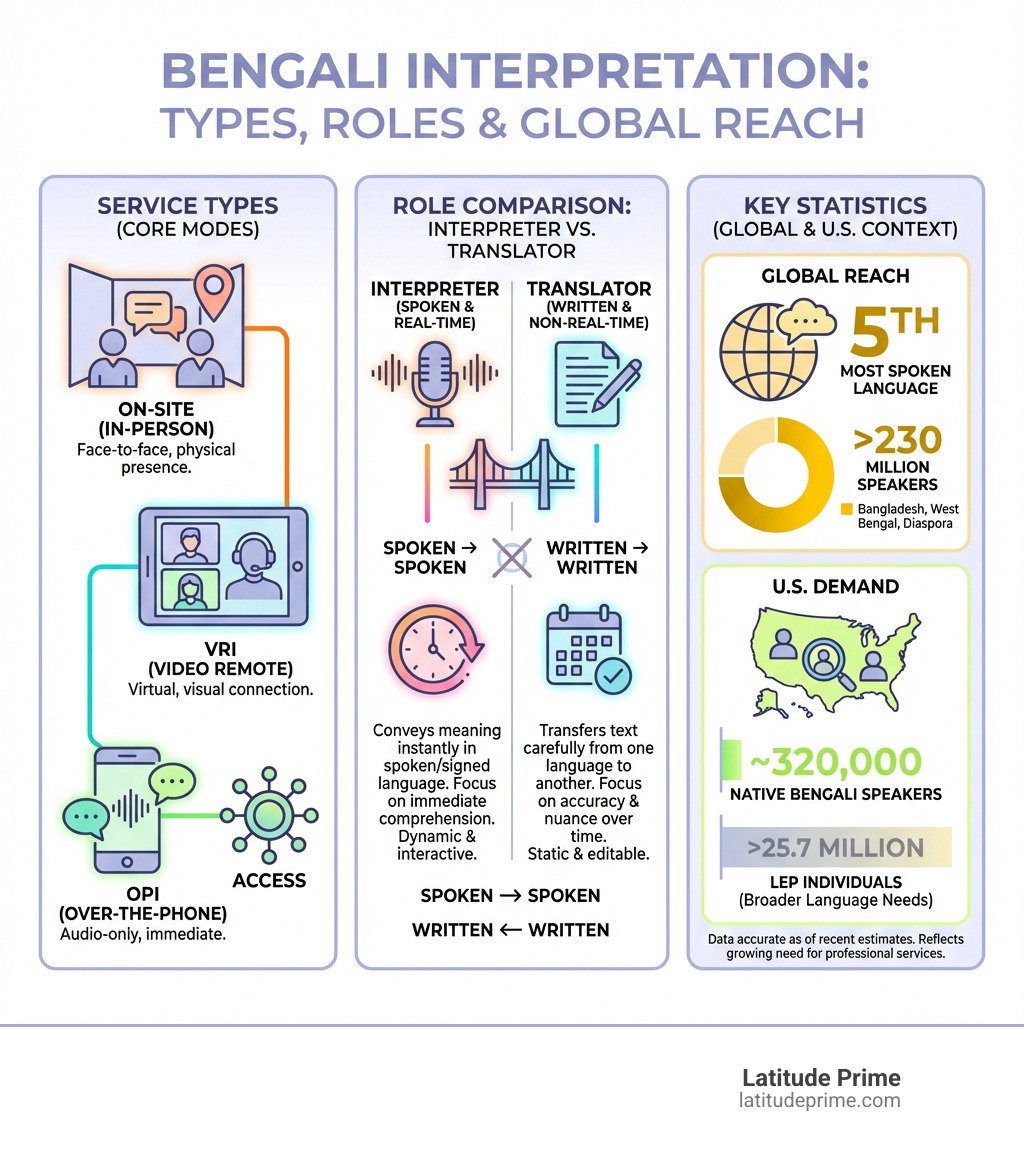
- Language Reach: Bengali is the 5th most widely spoken language globally, with over 230 million speakers across Bangladesh, West Bengal (India), and growing diaspora communities
- U.S. Demand: There are 320,000 native Bengali speakers in the United States and over 25.7 million limited English proficient (LEP) individuals who require language services
- Core Service Types: On-site interpretation, Video Remote Interpreting (VRI), and Over-the-Phone Interpreting (OPI)
- Primary Industries: Healthcare, legal services, immigration, education, and international business
- Not Translation: Interpreters work with spoken language in real-time, while translators work with written documents
With Bengali-speaking communities concentrated in areas like Brooklyn, New York and Dallas, Texas, the need for professional interpretation services has never been greater. Language barriers can lead to serious miscommunication in critical situations—from misdiagnosed medical conditions to misunderstood legal proceedings. That’s why professional interpreters go beyond simple word-for-word translation. They steer cultural nuances, regional dialects (like Sylheti, Chittagonian, and Rangpuri), and generational differences in language use to ensure accurate, culturally appropriate communication.
I’m William Kennedy, a Translation Project Manager who has overseen more than 8,500 language projects, including many requiring skilled interpreters in Bengali for technical, legal, and medical contexts. My experience has shown me how quality interpretation bridges communication gaps and ensures regulatory compliance in high-stakes environments.
What is Bengali Interpretation? Core Concepts and Services
At its heart, Bengali interpretation is the process of facilitating spoken communication between individuals who speak Bengali and those who speak another language, usually English. When we talk about an interpreter in Bengali, we’re referring to a skilled professional who acts as a linguistic and cultural bridge. In Bengali, such a professional might be referred to as a “দোভাষী” (dobhashi), emphasizing their role in speaking two languages.
Unlike translating written text, interpretation happens in real-time, demanding immediate comprehension, cultural sensitivity, and the ability to accurately convey meaning, tone, and intent without delay. This dynamic interaction is crucial in ensuring that messages are not just heard, but truly understood.

The Key Difference: Interpreters vs. Translators
While often used interchangeably by the general public, the terms “interpreter” and “translator” refer to distinct linguistic services with different skill sets and methodologies. Understanding this difference is fundamental to appreciating the specialized role of an interpreter in Bengali.
Interpreters deal with the spoken word in real-time, whether face-to-face, over the phone, or via video. This requires an immediate response, excellent memory, and the ability to process information on the fly. Their job is to bridge conversations as they happen, allowing people to converse seamlessly despite a language barrier.
Translators, on the other hand, work with written text like documents, websites, or legal contracts. This process is more deliberative, allowing them to use specialized tools to ensure precision and consistency. They have time to research terminology and refine phrasing for a polished final text.
Think of it this way: an interpreter is like a live performing artist, while a translator is a meticulous editor. Both are essential, but their stage and tools are entirely different. At Latitude Prime, we provide comprehensive Document Translation services for all your written Bengali needs, ensuring the same high standards of accuracy and cultural appropriateness that we demand from our interpreters.
Types of Bengali Interpretation Services
Just as conversations can take many forms, so too can interpretation services. We offer a range of solutions custom to different situations, ensuring effective communication no matter the context.
| Interpretation Type | Setting | Speed | Common Use Cases |
|---|---|---|---|
| Simultaneous | Conferences, large meetings, legal proceedings | Real-time (near-instant) | International conferences, live broadcasts, courtrooms |
| Consecutive | Medical appointments, interviews, small meetings, legal depositions | Turn-taking (speaker pauses for interpreter) | Doctor-patient consultations, client interviews, parent-teacher conferences |
| Video Remote (VRI) | Any location with internet access | On-demand or scheduled | Telehealth, quick legal consultations, business meetings |
| Over-the-Phone (OPI) | Any location with phone access | On-demand or scheduled | Emergency services, customer support, quick check-ins |
- Simultaneous Interpretation: This is the most demanding form, where the interpreter in Bengali translates in near real-time as the speaker talks. It requires immense concentration and is typically used for large conferences or live broadcasts where delays are unacceptable. Interpreters usually work from soundproof booths.
- Consecutive Interpretation: In this mode, the speaker pauses after a few sentences, allowing the interpreter in Bengali to convey the message. This turn-taking approach is common in medical consultations, client interviews, and smaller meetings. It allows for a natural conversation, though it extends the interaction’s total time.
- Video Remote Interpreting (VRI): VRI connects parties through video conferencing, offering the benefit of visual cues (body language, facial expressions) vital for nuanced communication. It’s an excellent on-demand option when an on-site interpreter isn’t feasible, widely used in healthcare and legal settings.
- Over-the-Phone Interpreting (OPI): For quick, on-demand language support, OPI connects an interpreter in Bengali to a phone call. It’s highly convenient for urgent situations, customer service, or when visual interaction isn’t necessary.
- On-Site Interpretation: When face-to-face interaction is required, an on-site interpreter in Bengali physically attends the event. This allows for direct engagement, better management of group dynamics, and handling of physical documents. Our On-Site Linguist Services ensure you have a professional present when it matters most.
Each type of service is designed to meet specific needs, and we pride ourselves on matching the right interpretation solution to your unique requirements.
The Value of a Professional Interpreter in Bengali
In a world that’s more connected than ever, the ability to communicate effectively across languages is not just a convenience—it’s a necessity. For businesses, healthcare providers, legal professionals, and government agencies operating in diverse communities, a professional interpreter in Bengali offers invaluable benefits that extend far beyond mere word conversion.
Consider the statistics: Bengali is the fifth most widely spoken language globally, with over 230 million speakers. In the U.S. alone, we have 320,000 native Bengali speakers, contributing to the over 25.7 million limited English proficient (LEP) individuals nationwide. These numbers underscore the critical demand for professional language services.
The benefits of utilizing a professional interpreter in Bengali are manifold:
- Accuracy and Clarity: Professional interpreters are trained to convey the exact meaning, tone, and context of a message. Without this precision, miscommunication can lead to serious errors, legal liabilities, or lost business opportunities.
- Compliance and Risk Mitigation: In sectors like healthcare and legal, regulations often mandate the provision of qualified interpreters for LEP individuals. Professional interpreters ensure compliance with privacy laws (like HIPAA) and ethical standards, reducing legal and financial risks.
- Cultural Expertise: Language is deeply intertwined with culture. A professional interpreter in Bengali brings not just linguistic fluency but also a profound understanding of cultural nuances, etiquette, and social norms, preventing misunderstandings that can arise from cultural differences.
- Improved Business Outcomes: For companies targeting Bengali-speaking markets or serving Bengali-speaking clients, professional interpretation fosters trust, improves client satisfaction, and facilitates smoother transactions, ultimately leading to better business relationships and growth.
- Efficiency and Professionalism: Relying on untrained bilingual staff or family members can be inefficient and unprofessional. A dedicated interpreter allows all parties to focus on the primary task at hand, knowing that communication is being handled expertly.
Common Industries and Scenarios
The need for a professional interpreter in Bengali spans a wide array of industries and situations, reflecting the diverse presence and contributions of Bengali-speaking communities in the U.S. and worldwide.

Here are some of the key sectors and real-world use cases where our services are frequently used:
- Healthcare: In settings from routine appointments to complex surgeries, accurate interpretation is life-saving. It ensures patients understand diagnoses and treatment plans, and helps medical professionals gather crucial information.
- Legal Services: In courtrooms, depositions, and client interviews, a precise interpreter in Bengali is essential for ensuring due process and equal access to justice, from explaining legal rights to translating witness testimonies.
- Business and Commerce: Facilitates international business meetings, client interviews, and cross-cultural negotiations. Clear communication is also vital for companies targeting Bengali-speaking markets.
- Education: Interpreters bridge communication gaps between educators and Bengali-speaking families during parent-teacher conferences, school enrollments, and special education meetings.
- Immigration: Assists individuals with visa applications, asylum interviews, and naturalization processes, ensuring accurate communication with immigration officials.
- Government and Social Services: Providing language access for public services, community outreach programs, housing assistance, and social welfare support.
- Conferences and Events: Ensuring accessibility for Bengali-speaking attendees at seminars, workshops, and public forums, through simultaneous or consecutive interpretation.
Whether it’s a critical medical diagnosis in Minneapolis, a complex legal proceeding in Washington D.C., a vital business negotiation in Miami, or an important school meeting in San Diego or Fort Lauderdale, our professional interpreters are there to ensure clear, effective communication.
Navigating Cultural Nuances: Beyond Words
True linguistic mastery goes beyond dictionary definitions. For an interpreter in Bengali, understanding and conveying cultural nuances is as critical as translating words accurately. Simply transposing words without cultural context can lead to misunderstandings or even offense.
Our professional interpreters are not just linguists; they are cultural ambassadors. They are acutely aware of:
- Subtext and Connotation: Words often carry implied meanings or emotional weight. A skilled interpreter in Bengali can discern and convey these subtleties, ensuring the full message and its underlying implications are understood.
- Non-Verbal Cues: A significant portion of communication is non-verbal. Our interpreters are trained to observe cues like facial expressions and body language, integrating them for a holistic understanding. As some sources suggest, non-verbal cues can make up 75%-93% of most interactions!
- Formality and Respect: Bengali culture places a strong emphasis on respect. Interpreters understand the appropriate use of formal vs. informal language, titles, and honorifics to ensure dialogue maintains the correct level of politeness.
- Generational Differences: In communities like those in the U.S., generational gaps can lead to distinct language usage. Younger Bengali speakers might blend English phrases into their Bengali, while older generations may be more familiar with traditional vocabulary or even Sanskrit influences. A professional interpreter in Bengali adapts their style to resonate with the specific individual they are interpreting for.
- Regional Customs: Cultural practices and communication styles can vary even within Bengali-speaking regions. An interpreter’s awareness of these regional customs helps them steer interactions smoothly and appropriately.
By skillfully handling these cultural intricacies, our interpreters ensure that communication is not only linguistically precise but also culturally appropriate and genuinely effective, fostering trust and mutual understanding.
The Path to Becoming a Qualified Bengali Interpreter
Becoming a qualified interpreter in Bengali is a rigorous journey that demands far more than just being bilingual. It requires a deep commitment to linguistic excellence, cultural understanding, and ethical practice. At Latitude Prime, we understand that the quality of our services hinges on the caliber of our linguists, which is why we adhere to stringent standards for qualification.
How to become a qualified interpreter in Bengali
The path to becoming a highly sought-after interpreter in Bengali involves several key stages:
- Exceptional Language Fluency: This foundational requirement demands native-level proficiency in Bengali and near-native fluency in English (or the target language), including an extensive vocabulary, mastery of grammar, and idiomatic expressions in both.
- Formal Education and Training: Professional interpretation is a learned skill, often through specialized training programs or academic degrees. These programs teach core techniques like consecutive and simultaneous modes, memory retention, and note-taking.
- Gaining Extensive Experience: Practical experience is invaluable. Interpreters build skills by working in various settings, from community services to high-stakes legal or medical environments. Reputable services often require a minimum of 2-4 years of experience for complex cases.
- Professional Certifications: While not always legally mandated, certifications demonstrate a high level of competence. Organizations like the Certification Commission for Healthcare Interpreters (CCHI) or the National Association of Judiciary Interpreters and Translators (NAJIT) offer credentials that validate an interpreter’s skills. HIPAA certification is also often required for healthcare.
- Subject Matter Expertise: Many assignments require specialized knowledge. A qualified interpreter in Bengali might specialize in legal, medical, or technical terminology, allowing them to accurately convey complex concepts. This often involves continuous professional development.
- Adherence to a Code of Ethics: Professional interpreters abide by a strict code of ethics, including confidentiality, impartiality, accuracy, and professionalism. This ensures they act as neutral facilitators, prioritizing message integrity and the privacy of all parties.
Specializing in Bengali Dialects
Bengali, like many widely spoken languages, is rich in regional variations and dialects. While there is a “Standard Bengali” (often referred to as Shuddho Bhasha, particularly in West Bengal, India, and Dhaka, Bangladesh), the spoken language features several distinct dialects. For an interpreter in Bengali, understanding these nuances is paramount.
Our expert linguists can specialize in particular dialects, ensuring that communication is not only accurate but also culturally appropriate and relatable to the specific Bengali speaker. Key dialects include:
- Sylheti: Predominantly spoken in the Sylhet Division of Bangladesh and the Barak Valley of Assam, India. It has distinct phonology and vocabulary that can differ significantly from Standard Bengali.
- Chittagonian: Spoken in the Chittagong region of Bangladesh, this dialect is known for its unique tonal qualities and vocabulary, sometimes making it challenging for speakers of other Bengali dialects to understand without prior exposure.
- Rangpuri: Spoken in the Rangpur Division of Bangladesh and parts of West Bengal, India, it shares some similarities with Assamese.
The importance of dialect matching cannot be overstated. Dialect matching is crucial, as meanings can differ between Bengali spoken in India and Bangladesh, or even by generation. A skilled interpreter in Bengali adapts to these differences, from the English-mixed speech of younger speakers to the Sanskrit-rooted vocabulary of older generations. This ensures the message resonates and makes our Bengali Translations and interpretation services truly comprehensive.
Modern Bengali Interpretation: Costs and Technology
The landscape of language services is constantly evolving, with technology playing an increasingly significant role. This evolution also impacts the cost structures and accessibility of securing an interpreter in Bengali. Understanding these factors helps us provide the most efficient and cost-effective solutions for your needs.
How Technology and AI are Shaping the Industry
Technology has revolutionized how we access and use interpretation services, making them more immediate, flexible, and often more affordable.
- Video Remote Interpreting (VRI) and Over-the-Phone Interpreting (OPI): These technologies have made on-demand language support accessible from virtually anywhere. Instead of waiting for an on-site interpreter, you can connect with a professional interpreter in Bengali within seconds or minutes. This is particularly beneficial for urgent situations or locations where on-site interpreters are scarce. VRI platforms also allow for the capture of non-verbal cues, which are vital for comprehensive understanding.
- AI-Powered Translation and Captions: Artificial intelligence is making strides in language processing. While AI-powered tools cannot replace human interpreters for nuanced, high-stakes communication, they can augment services. For instance, AI live translation can convert spoken language into translated captions for hybrid events, webinars, or meetings, offering an additional layer of accessibility. These tools are excellent for basic understanding or large-scale content processing.
- Integration with Communication Platforms: Modern interpretation services seamlessly integrate with popular communication platforms like Zoom, Cisco Webex, and Microsoft Teams. This allows for easy setup of multilingual meetings, events, and webinars, facilitating global collaboration.
- Hybrid Events: Technology enables hybrid events where some participants are in-person and others join remotely, with interpretation services bridging the language divide for all attendees.
While technology offers incredible benefits in terms of speed, accessibility, and cost-effectiveness, it’s crucial to understand its limitations. AI translation, while improving, still struggles with cultural nuances, idiomatic expressions, sarcasm, and the emotional context that a human interpreter in Bengali effortlessly provides. For critical, sensitive, or high-stakes interactions, human interpretation remains indispensable. We continually explore and integrate the best technological advancements to improve our services while always prioritizing the human element for accuracy and cultural integrity. To learn more about our approach to language technology, you can always visit our News & Publications / Blog.
What are the estimated costs for an interpreter in Bengali?
The cost of hiring an interpreter in Bengali can vary widely depending on several factors. Our goal is to provide transparent and competitive pricing that reflects the high quality and specialized nature of our services. Generally, pricing models include:
- Per-Minute Rates: This is a common model for remote interpretation services (VRI and OPI). Rates are typically charged based on the actual duration of the interpretation session. Factors influencing this rate include the language pair, the specialization required (e.g., medical, legal), and whether the service is on-demand or scheduled.
- Per-Hour Rates: For on-site interpretation, interpreters are usually booked for a minimum number of hours (e.g., 2-4 hours), followed by an hourly rate for additional time. This covers the interpreter’s travel time and ensures their availability for the duration of your event.
- Project-Based Fees: For larger, more complex projects like multi-day conferences or extensive legal proceedings, a customized project fee might be negotiated. This can include preparation time, specialized equipment, and multiple interpreters if simultaneous interpretation is required.
Factors influencing the cost include:
- Type of Interpretation: Simultaneous interpretation, being more demanding, is typically more expensive than consecutive.
- Mode of Delivery: Remote (VRI/OPI) services often have lower overheads than on-site services, making them generally more cost-effective for shorter durations.
- Specialization: Interpreters with specific industry expertise (e.g., medical, legal, technical) often command higher rates due to their specialized knowledge and certifications.
- Urgency and Availability: On-demand services might have a different rate structure compared to services scheduled well in advance.
- Location: While our remote services are globally accessible, on-site services in specific locations like Minneapolis, Washington D.C., San Diego, Miami, or Fort Lauderdale will factor in local market rates and travel expenses.
To get an accurate estimate for your specific needs, we always recommend requesting a personalized quote. This allows us to understand the scope of your project, the required specialization, and the preferred mode of interpretation, so we can provide you with the most suitable and cost-effective solution.
Frequently Asked Questions about Bengali Interpretation
We understand you might have more questions about how our services can best meet your needs. Here are answers to some commonly asked questions about working with an interpreter in Bengali.
Can I use a bilingual family member instead of a professional?
While it might seem convenient or cost-effective to use a bilingual family member or friend, we strongly advise against it for professional or sensitive situations. The risks are substantial:
- Confidentiality Issues: Family members are not bound by professional codes of ethics, which could lead to breaches of privacy, especially in medical or legal contexts. Professional interpreters adhere strictly to confidentiality agreements.
- Lack of Technical Vocabulary: Casual bilingual individuals rarely possess the specialized vocabulary required for fields like medicine, law, or technical discussions. This can lead to critical inaccuracies and misunderstandings.
- Emotional Bias: A family member’s emotional involvement can compromise impartiality. They might filter information, soften bad news, or inject their own opinions, distorting the original message.
- Professional Ethics: Professional interpreters are trained to be neutral conduits of communication. Family members often lack this training and may inadvertently advise, omit, or add information, which is a serious ethical breach for an interpreter.
- Compliance: In many regulated industries, using a qualified, certified professional interpreter in Bengali is a legal requirement to ensure equal access and protect patient/client rights.
For accurate, confidential, and unbiased communication, a professional interpreter in Bengali is always the best choice.
How quickly can I access a Bengali interpreter?
The speed of access depends on the type of interpretation service you require:
- On-Demand (VRI & OPI): For Video Remote Interpreting (VRI) and Over-the-Phone Interpreting (OPI), we can often connect you with a professional interpreter in Bengali in a matter of seconds to minutes. Our advanced platforms are designed for rapid deployment, making them ideal for urgent needs or unexpected language barriers.
- Scheduled On-Site Interpretation: For on-site services, we recommend scheduling in advance to ensure the availability of a qualified interpreter in Bengali with the specific expertise you need. While we can sometimes accommodate same-day requests, scheduling ahead provides the best guarantee for a perfect match.
- 24/7 Availability: Many of our remote interpretation services are available 24 hours a day, 7 days a week, ensuring that language support is always just a call or click away, regardless of time zones or emergency situations.
What makes a Bengali interpreter “qualified”?
Being “qualified” goes far beyond simply speaking two languages. A truly qualified interpreter in Bengali possesses a unique combination of skills, training, and ethical commitment:
- Beyond Bilingualism: They have native-level fluency in Bengali and near-native fluency in the target language (e.g., English), including advanced vocabulary, grammar, and cultural idioms in both.
- Specialized Training: They have undergone formal training in interpretation techniques, including consecutive and simultaneous modes, note-taking, and memory retention strategies.
- Industry-Specific Knowledge: Many qualified interpreters specialize in particular fields (medical, legal, technical) and possess the necessary terminology and understanding of the subject matter to ensure accurate communication of complex concepts.
- Adherence to a Code of Ethics: They are committed to strict ethical principles, including confidentiality, impartiality, accuracy, and professional conduct, ensuring unbiased and trustworthy communication.
- Cultural Competency: They possess a deep understanding of both Bengali and the target culture, allowing them to steer cultural nuances, non-verbal cues, and social protocols that are crucial for effective communication.
- Certifications: While not always mandatory, professional certifications (e.g., CCHI, NAJIT) and ongoing professional development are strong indicators of a highly qualified and committed interpreter.
At Latitude Prime, we ensure that all our linguists meet these rigorous standards, providing you with the highest quality and most reliable interpreter in Bengali services available.
Conclusion: Your Partner in Clear Communication
In today’s interconnected world, clear and accurate communication is the cornerstone of success, whether in business, healthcare, legal proceedings, or personal interactions. The role of a professional interpreter in Bengali is not merely to translate words, but to expertly bridge linguistic and cultural divides, ensuring that every message is conveyed with precision, nuance, and respect.
We’ve explored the critical distinctions between interpretation and translation, digd into the diverse types of interpretation services available, and highlighted the immense value that professional interpreters bring to countless industries. We’ve also touched upon the vital importance of cultural sensitivity, the journey to becoming a qualified linguist, and how technology is shaping the future of our field.
At Latitude Prime, we are committed to being your trusted partner in achieving seamless multilingual communication. Our ISO-certified quality management system and extensive network of expert linguists ensure that you receive nothing less than the highest standards of accuracy and professionalism. When you choose us, you’re choosing a team dedicated to breaking down language barriers and fostering genuine understanding.
Don’t let language be a barrier to your success or to effective communication. Connect with our expert linguists for your Interpretation Services today and experience the difference that professional Bengali interpretation can make.
